
11 Best Things to Do in Nowa Huta, Kraków: A Soviet-Era District
If you are interested in communist history, Socialist Realist architecture, and the less well-known aspects of the city, the district of Nowa Huta in eastern Kraków is worth exploring. Originally constructed as an ideal socialist city around the steelworks, there are plenty of things to do in Nowa Huta, such as visiting its impressive central square and the former workers’ areas, as well as finding the Cold War-era shelters and other odd remnants of its communist past.
This area is the most recent extension of the city’s boundaries, established in 1951, yet it is completely unlike any of the Kraków landmarks in the city center. It was previously a separate Socialist city laid out in a central plan on the Vistula River.

A few years ago, I came across information about Nowa Huta and immediately added it to my Krakow itinerary for a future visit, as I am a huge fan of Soviet architecture.
Since there is very little English-language material on sightseeing in Nowa Huta, I have written this comprehensive guide and updated it in 2026 to provide all the information you need to arrange a self-guided tour of the area. Of course, if you would rather walk with a local and gain a better understanding of the area, you can book a Nowa Huta walking tour.
Disclaimer: Some of the links in this post are affiliate links, which means I may earn a small commission if you buy something through them—at no extra cost to you. It helps support my blog and lets me share real, first-hand travel tips. Learn more
Why is Nowa Huta worth visiting?
Known literally as “The New Steel Mill,” it is one of the most populated areas in Krakow, with a population exceeding 200,000. The area is also one of the two cities in the world that was precisely planned and constructed from scratch in the socialist-realist style (the other being Magnitogorsk in Russia).
The local Soviet authority first established Nowa Huta, Krakow, in 1949 as a model communist city meant to demonstrate the power and superiority of the Soviet Union, and it formed the area of Nowa Huta by taking over the territories of three villages: Mogiła, Pleszów, and Krzesławice.

It was built as a utopian and ideally socialist city for the working class, with urbanization and functionality being the key features of its design; wide roads help prevent fires from spreading, the huge block of flats is symmetrical, and the numerous green spaces together with the trees along the avenues ensure a healthier environment.
It was used not only as a model of an idealized city for Soviet propaganda but also as the site of the Vladimir Lenin Steelworks, a steel plant that opened in 1954. Within twenty years, the factory had become the largest in the country, producing steel continuously around the clock, with tens of thousands of people working on three shifts.
In the 1960s, Nowa Huta grew quickly with ever more huge buildings appearing around Plac Centralny, or Central Square. In the 1970s, the steelworks had almost 40,000 employees and produced about 6.7 million tons of steel each year.

The reasons for building the Nowa Huta industrial city are not clear; they were probably based on ideological considerations, since the government had to transport coal from Silesia and iron ore from Ukraine in order for the enterprise to function properly, and as the demand for locally produced steel was low, the steel was sent to other parts of the country.
The communist authorities were quite proud of the project when it was completed and showed it to their most distinguished guests, including Fidel Castro, Charles de Gaulle, Nikita Khrushchev, and Indira Gandhi, to name a few.
Another good reason to visit Nowa Huta is that the area has about 250 underground shelters; these bunkers were constructed for the people living in residential blocks, schools, clinics, and other public buildings in the event of a missile or nuclear attack.
Even though the local government had been trying to keep it an ideal city, Nowa Huta was the site of numerous protests organized by the Solidarity movement in the 1980s, eventually leading to the downfall of communism in Poland. The idea of having a perfect socialist city was never completely realized.


Nowa Huta is becoming one of the most popular destinations in Kraków today. For anyone who wants to learn more about life in communist Poland, a visit to Nowa Huta is one of the best activities in Kraków for those interested in Soviet history and urbex.
Following the collapse of the Soviet Union, streets that had been named after Vladimir Lenin and other figures of the communist regime were renamed to honor a variety of religious and political figures, as well as Polish World War II heroes such as Pope John Paul II and Władysław Anders.
Plac Centralny, which once had a statue of Lenin, was renamed to Plac Centralny im. Ronalda Reagana, or Ronald Reagan Central Square, honoring the former US President.
Plan Your Trip Like A Pro
How to get to Nowa Huta from Krakow center
The Nowa Huta district, located only 8 km from the city center, is easy to reach via well-connected public transport. Trams No. 4 and 10 go directly from Teatr Słowackiego station in Krakow city center, taking around 25 minutes to reach Central Square in Nowa Huta.

Should you begin your visit to the district at the administrative building known as the Steelworks, as mentioned below, you will need to take tram number 4 to reach Kombinat, the final stop.
Krakow Nowa Huta Map
For a more convenient way to explore the neighborhood, here is a Google Maps list of the things to do in Nowa Huta that you can save and use whenever you need it. If you download the area for offline use, you will not need the data to access the spots.
11 best things to do in Nowa Huta
The district is very large and has a number of attractions spread out over its area. This Nowa Huta itinerary is perfect for spending either a full or a half day in the area and gaining a better understanding of its history and culture by strolling through the streets on your own or taking a guided tour.
Visit the administration building and bunker of Steelworks
Nowa Huta is home to one of the largest steel plants in the country, covering about 600 ha. Because of a local organization called Fundacja Promocji Nowej Huty, which aims to promote Nowa Huta as a tourist destination, you can take part in the tour and see the most extravagant and little-visited administrative buildings of the former Vladimir Lenin Steelworks.
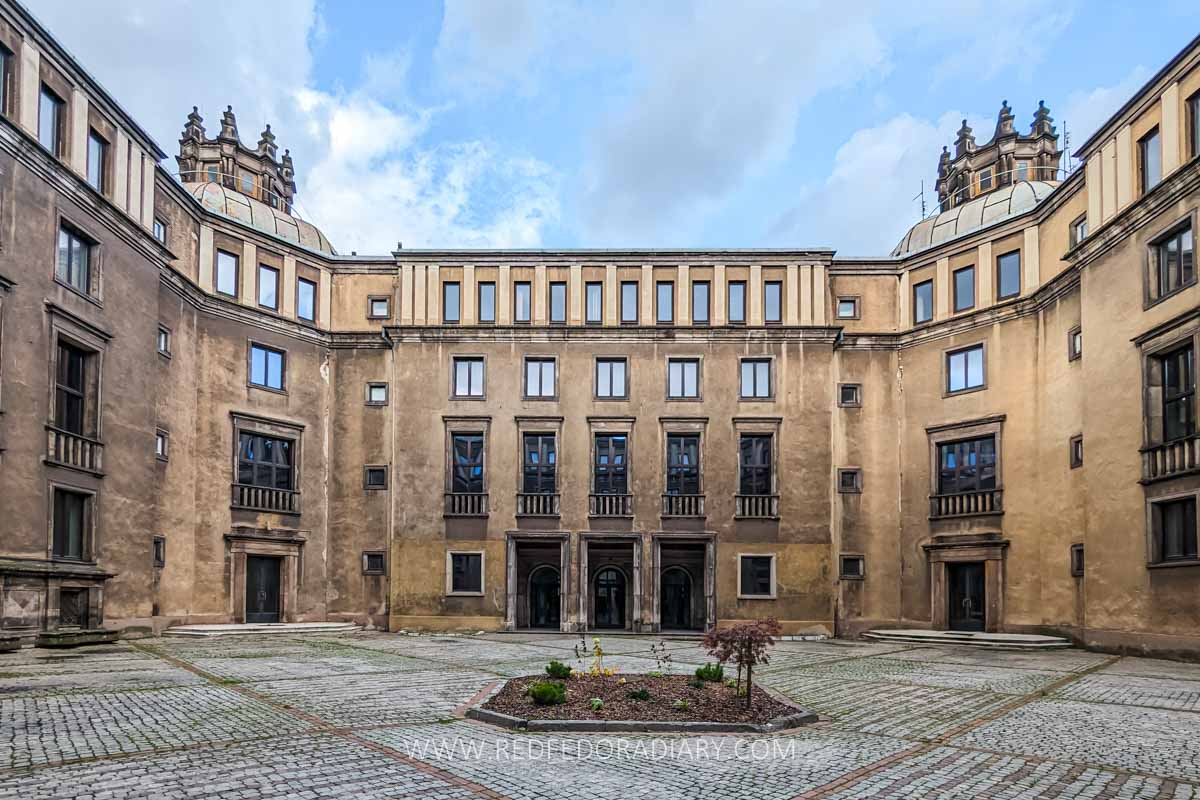
Following the breakup of the Soviet Union, the factory was renamed in honor of the Polish scientist and engineer Tadeusz Sendzimir and still bears his name – Tadeusz Sendzimir Steelworks. Although its capacity decreased, the steel mill kept on operating, and this eventually caused the Mittal Steel Company to buy it in 2005.
Starting the tour is one of the best things to do in Nowa Huta because your guide will explain how the buildings and their bunkers were designed, and briefly introduce Polish history during communist times.


The Steelworks can be reached via two identical buildings that were previously used as administrative offices. The only sections of the Steelworks complex that are now open to tourists are these buildings, and tours are available only on a guided basis. Self-guided walking tours are not permitted, but the guided tour is well worth it.
The main administrative building is impressive, with its architecture drawing inspiration from the Vatican and Wawel Castle in Krakow. Unlike such grand Soviet-era buildings in Tskaltubo, it is largely untouched and still has much Soviet-era memorabilia, original furniture from the 1960s, and technical equipment that still works today.


The management of the steelworks is still using these buildings, keeping them rather intact as they were. Nevertheless, a few of the rooms have been remodeled; your guide will show them to you.
To walk around this building is as if you were traveling back in time; you can feel the atmosphere of bygone days when directors used to take delegations round the steelworks and received guests from the Eastern Bloc.
You are taken through one of the largest conference halls, where most of the original furniture remains, and a beautiful ceiling with a chandelier is present; the spiral staircases are also very impressive, as is the CEO’s office, which has a private area.

The office of the engineer contains a map of the plant that shows its extent. As I looked at it in amazement, Mateusz, our guide, mentioned that there had previously been 15 bus routes within the steelworks to take workers to their assigned workstations; nowadays there are about 7.
When you have finished looking round the building, the tour continues to an underground bunker situated between the two administrative buildings; this bunker was previously used as a command center. By the way, Tbilisi also has a Soviet-era bunker that served as a communications center in case of an emergency.

The bunker had a capacity of about 50 people, with a maximum of 75. One of the most interesting rooms in the bunker is the commander’s room, which contains dozens of telephones, maps, warning signals, and a weather board. While a crisis was occurring, the staff from the steelworks would co-ordinate operations throughout the plant and its shelters from this room.
The shelter included telephone booths to maintain contact with the outside world, and a separate room with three-tiered bunk beds for staff to rest in an emergency.


It also had a manual backup system: should the power fail, it could be operated by pedaling a bicycle.
The tour takes about two hours and includes a number of exciting stories which the members of the Fundacja Promocji Nowej Huty tell you.
If you’d like to see the former Steelworks administrative buildings, you can only do so as part of a guided tour that also covers the underground bunker. You can book the Steelworks tour by clicking here.
If you want to find out more about Nowa Huta with a local guide, the foundation also offers a guided tour of the area in a classic car, highlighting its architecture from the communist period, its history, and some of the lesser-known parts. You can find out more about the classic car tour here.
Come back to Plac Centralny
When the tour is over, return to Plac Centralny, which is a 31-minute walk or an 8-minute tram journey away.

Five main streets radiate from this huge square. Although the original plans had provided for a town hall at the northern end, changes were made after 1956, when Nowa Huta was incorporated into Kraków. Likewise, the southern part was to have a large theatre, though it, too, was never completed.
Peek inside the Nowa Huta Cultural Center
The Nowa Huta Cultural Center, located south of Plac Centralny, offers a variety of activities—such as concerts, workshops, and exhibitions—year-round.
If you’re interested in having a little snack, the Encek food trucks have a range of food available, and our favorite was the Chebureki.
Stroll through Rose Avenue
Rose Avenue, or Aleja Róż, is a street that extends from Plac Centralny and was originally intended for all kinds of processions and demonstrations, with the sides of the street decorated with roses.

As you walk along the promenade, take in the symmetrical architectural designs, which show the interesting ideas that went into their creation.
Have lunch at a milk bar or at Stylowa restaurant
Why not take a break from all the sightseeing to have lunch at one of the milk bars or at Stylowa, the oldest restaurant in Nowa Huta (which opened in 1956)? The milk bar was closed during our visit, so we chose Stylowa.

At that time, it was one of the most elegant and fashionable first-class establishments in the district, and people used to go there for dinner and to dance. Nowadays, it is a leftover from the past but an ideal place to experience a real local way of life.
They serve local Polish food that was good—not particularly fancy or especially delicious—but the atmosphere—with the archival photos and the general feel of the communist era—made it a worthwhile visit.
See the real tank parked on the streets
One of the free things to do in Nowa Huta is to walk to 23 Ignacego Mościckiego Street and find the IS-2 Tank Monument.

The unit, which was the 5th Heavy Tank Regiment of the Polish Second Army, was employed in Poland and Czechoslovakia (that is, the present-day Czech Republic and Slovakia) in April 1945 and destroyed four armored vehicles, three artillery pieces, and two tanks.
Learn about the Polish People’s Republic (PPL) at the Nowa Huta Museum
2026 update: the Światowid building is under construction, and the museum is closed
The Nowa Huta Museum, formerly Kino Światowid, offers a view of how Poles lived during the Soviet era. It has two exhibition areas, one on the ground floor and the other in the shelter, making it an excellent place to visit if one is unable to go on the Steelworks tour.

During our visit, there was an exhibition of communist toys on the ground floor. It was enjoyable to look around the various stalls and see what kinds of toys children used to play with in a Soviet country different from my own. We noticed some toys that we also had when we were growing up in Georgia.

Actually, the underground shelter in this location was less impressive than the one featured in the Steelworks tour. It nevertheless manages to illustrate the Cold War and Soviet-era propaganda well, with information boards along the walls and a few items from that period on display in various rooms.
Tour more underground shelters
As mentioned above, it is believed that Nowa Huta has more than 250 underground bunkers which were constructed in the 1950s in the event of an air raid or a nuclear war; although some of them are closed, others have been turned into museums and are open to the public.
If you’d like to see another shelter while you’re in Nowa Huta, one thing you could do is go through the bunker beneath the Mechanical School Complex No. 3 at the Szkolny 37 site, which is called the Nowa Huta Underground, there being an exhibition on the dangers and the natural human tendency to hide from them.
- Opening hours: Wed-Sun 10 am to 5 pm; Closed on Mon
- Entrance fee: family (max. 4 people) – 44 PLN; FREE on Tuesdays. More info
See the most unusual church
Since the socialist vision of a utopian community involved atheism, churches were clearly left out of this rapidly constructed city, and Nowa Huta was seen as a godless city. Yet its religious residents, who were mainly from the villages, were not willing to give up their faith.


They tried several times to have their views heard, but it was during the 1960 demonstrations that the most progress was made, which led to a number of arrests.
The construction of the Ark of the Lord and the first church was ultimately carried out between 1967 and 1977 by volunteers, as the government did not provide support despite receiving considerable assistance and pressure from the future Pope John Paul II.
Inspired by the style of Notre-Dame du Haut, a Roman Catholic chapel in Ronchamp, France, it is one of the most unusual ones I’ve ever seen. It has a boat-shaped form which is similar to Noah’s Ark from the outside. The cross, which is 70 meters tall and rises above the church, also resembles a mast. Even though the cross is symbolic, it is also part of the structural framework.


The church has seven doors, representing the seven sacraments, and seven steps leading to the altar, which stand for the seven gifts of the Holy Spirit.
The large, prominent crucifix, which stands above the chancel, is a striking work of art, depicting Christ being nailed to the cross while also suggesting that he is about to fly into heaven.
The eight small bells suspended above the entrance were given by the Catholics of Belgium and the Netherlands; the people named are those who helped build the church, and the bells play popular church melodies each hour between 6 a.m. and 9 p.m.
Enjoy a stroll along the Zalew Nowohucki Park
One of the best things to do in Nowa Huta at sunset is to take a relaxing walk around the lake in Zalew Nowohucki Park.
It looks particularly magical in spring or summer, but it was still quite beautiful when we visited in November for the fall foliage.

The kind of architecture associated with Stalinism and socialist realism is generally regarded as consisting of grey buildings and a great deal of concrete. One might be surprised, however, to find that Nowa Huta is quite green, featuring numerous parks and gardens, and that its wide streets give it a less “ugly” or “suffocating” appearance than many other Soviet housing blocks I have visited.
Zalew Nowohucki is an artificial lake covering 40 acres, surrounded by green spaces; on warm summer days, it is possible to kayak on the lake, spend an afternoon at its little beach, or take part in various sports.
Also, when you’re walking around, note the small island in the lake, which the locals call Małpim Gajem, or Monkey Grove, because it is home to a variety of plant and animal species.
Have a drink at Klub Kombinator
If you are here all day and then ask yourself what to do in Nowa Huta in the evening, you should visit Klub Kombinator before heading back to the center.
Klub Kombinator has a design that is both varied and straightforward, giving it the atmosphere of a dive bar and placing it near Zalew Nowohucki Park. The staff is friendly and helpful, and the prices are extremely reasonable. So, if you’ve been seeing a lot of sights, come to this place to relax, have a cocktail or your preferred drink, and enjoy the local nightlife.
FAQs about Nowa Huta
Where is Nowa Huta in Kraków?
Nowa Huta is a big area in eastern Kraków and was developed after the Second World War as a planned socialist city centered on the Lenin Steelworks. At present, it is famous for its monumental Socialist Realist architecture, its wide avenues, its green spaces, and the remnants of its communist era.
What is Nowa Huta known for?
Nowa Huta is best known for its history during the communist period and its Socialist Realist architecture; it was designed in the 1940s and 1950s as an ideal socialist city and built around a large steelworks.
The main features of the area are Plac Centralny, Aleja Róż, the former steelworks complex, the shelters from the Cold War era, and a number of particular churches.
Is Nowa Huta safe to visit?
Nowa Huta is usually safe to visit. Even though the area has a bad reputation in the past, it has undergone considerable changes over the years. As is the case in any part of Kraków, take the usual precautions, particularly at night, but you have no need to avoid Nowa Huta for safety reasons.
How much time do you need in Nowa Huta?
If you want to see the main attractions in Nowa Huta without feeling rushed, then plan to spend at least half a day there. While you’ll be able to see the central area and a number of the most important buildings in a few hours, you should spend more time if you wish to visit the steelworks, explore the underground shelters, or go on a guided tour.
Can you visit Nowa Huta without a tour?
Yes, it is easy to see a great deal of Nowa Huta on your own, the main squares, streets, churches, and the Socialist Realist buildings all being freely accessible and reachable by tram or on foot. The exception is that some sites, such as parts of the former steelworks and its underground shelters, can only be seen on a guided tour.
What are the Nowa Huta underground shelters?
The underground shelters in Nowa Huta were constructed during the Cold War as a measure for protection in the event of an attack. Throughout the district, hundreds of shelters were built, both under residential buildings and in public areas. Today, some of them are still open to the public and offer a view of how Kraków prepared for a possible Cold War emergency.
How far is Nowa Huta from Kraków Old Town?
Nowa Huta is about 8 km from the old part of Kraków; if you’re going to other places in the district, the tram journey from the city center usually takes 25 to 40 minutes. It is generally the simplest way to reach it by public transport.
Is Nowa Huta in Zone 1?
Yes. Nowa Huta is within Kraków’s public transport Zone I, so you can reach the district from the city center using a standard Zone I ticket. However, always check the current Kraków public transport map and ticket rules before traveling, as routes and fares can change.