
Self-Guided Prague Walking Tour: One Day in Prague
Prague, the capital city of Czechia, or the Czech Republic, is a popular destination for travelers worldwide. Known for its stunning architecture, rich history, and vibrant culture, it is a city with something for everyone. Walk through its millennial history with this self-guided free Prague walking tour I perfected myself.
I studied in Prague for four years and would occasionally get family and friends visiting me. Therefore, I would always act as a tour guide, showing them the best the city has to offer.
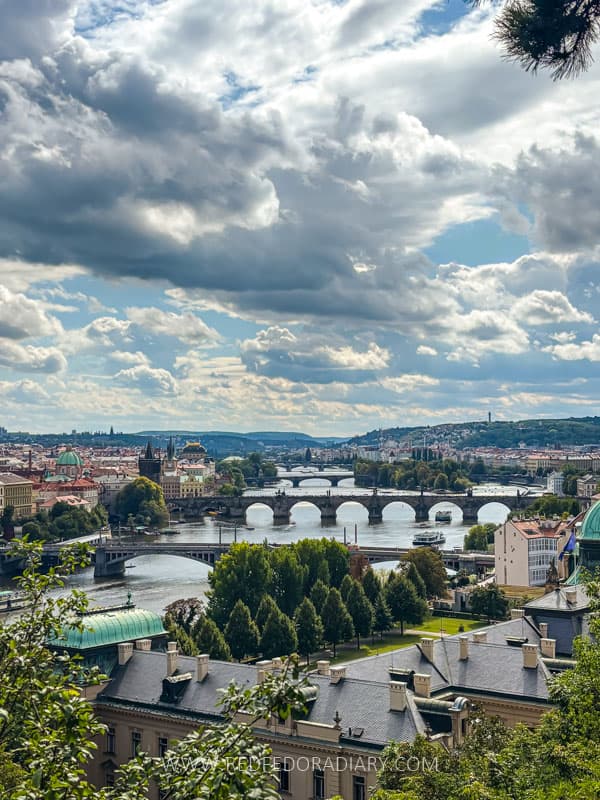
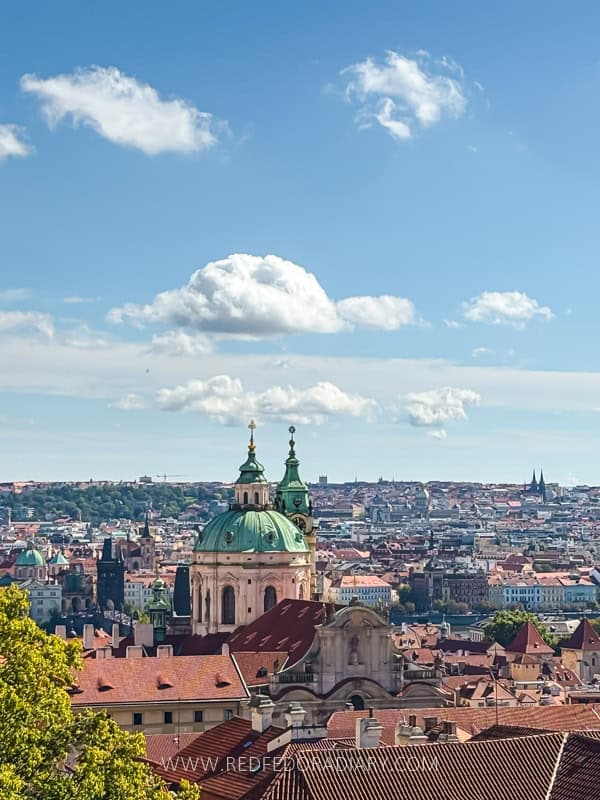
Over time, I perfected the route to help you see the most iconic Prague landmarks in a day, leaving more time to enjoy other things, such as shopping, nightlife, visiting its fascinating museums, or going on day trips, to name just a few. However, if you have more time, here’s your two-day itinerary for Prague to take it slower.
This Prague self-guided, and free walking tour starts from Wenceslas Square, goes to Prague Castle by crossing the Charles Bridge, and returns to Old Town Square via the other side of Lesser Town.
The free tour takes you through the city’s major landmarks, public buildings, cultural venues, and places of worship.
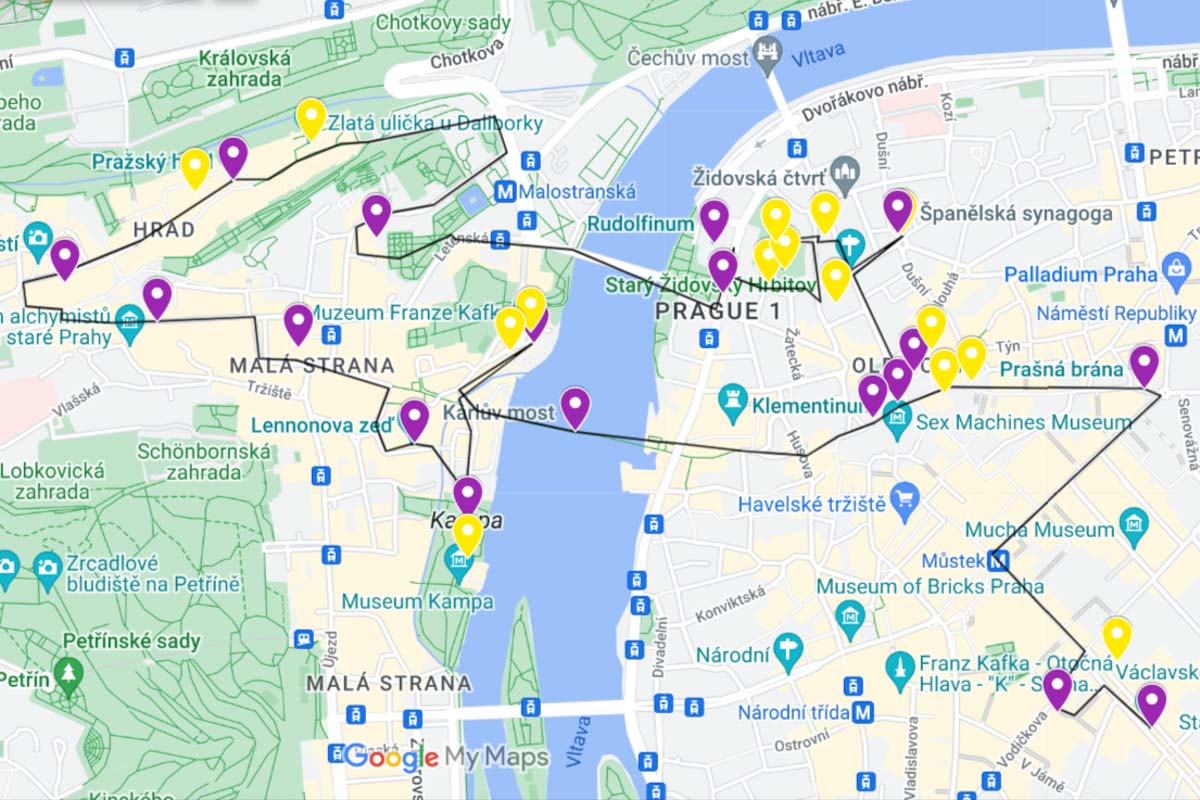
This walking tour covers approximately 8-9 km. You can easily make it your one-day Prague itinerary depending on when you start, your pace, and how long you stay in each location.
Some of the stops on this self-guided Prague walking tour, like Prague Castle, Golden Lane, or the Jewish Quarter, require an entry ticket, and those fees can add up. To keep your sightseeing budget-friendly, I recommend getting a Go City Pass to save up to 50% on top attractions and explore at your own pace.
The tour is flexible, so feel free to take a break or omit things that are of no interest to you.
In addition to providing the route for the best Prague walking tour, this post also covers essential Prague travel tips and a few recommended guided walking tours.
🧭 Planning your time in Prague?
- Choosing the right area to stay can also make a big difference—here’s where to stay in Prague based on your travel style.
- If you’re planning to visit museums along the way, don’t miss my guide to the best museums in Prague to help you decide what’s worth your time.
- And if you have extra time, don’t miss these easy day trips from Prague.
Disclaimer: Some of the links in this post are affiliate links, which means I may earn a small commission if you buy something through them—at no extra cost to you. It helps support my blog and lets me share real, first-hand travel tips. Learn more
Prague walking tour map
For a more comfortable way to explore the city and follow directions, I have created a Prague walking tour map on Google Maps that you can save and use whenever you need it. The purple pins on the map mark the main stops on the walking tour, while the yellow pins are the significant locations that I explain within the territory.
Key takeaways
Recommended tours in Prague:
Self-guided Prague walking tour
Wenceslas Square
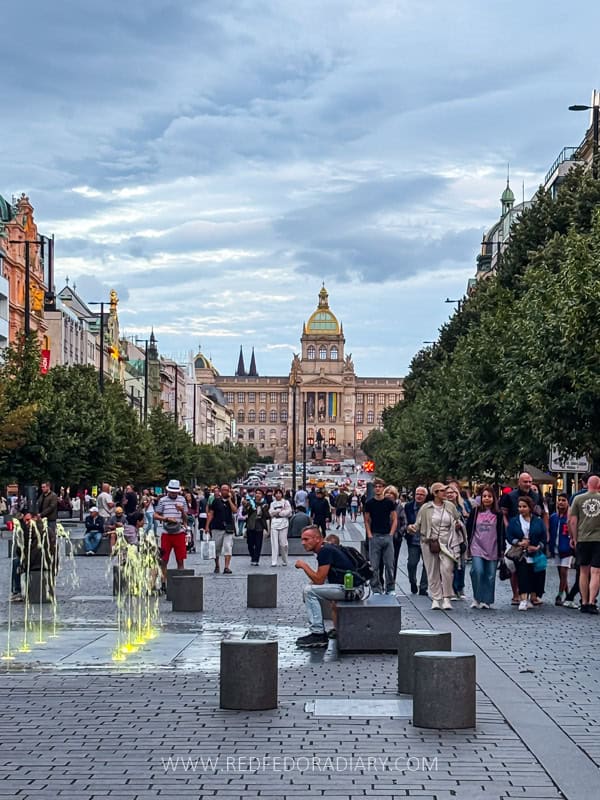
Václavské náměstí, or Wenceslas Square, is one of Prague’s main areas and a place where many locals meet. It has also been a landmark of many historical events, such as demonstrations, celebrations, and other public gatherings. Named after Saint Wenceslas, Bohemia’s patron saint, the area is more of a 750-meter boulevard than a square.
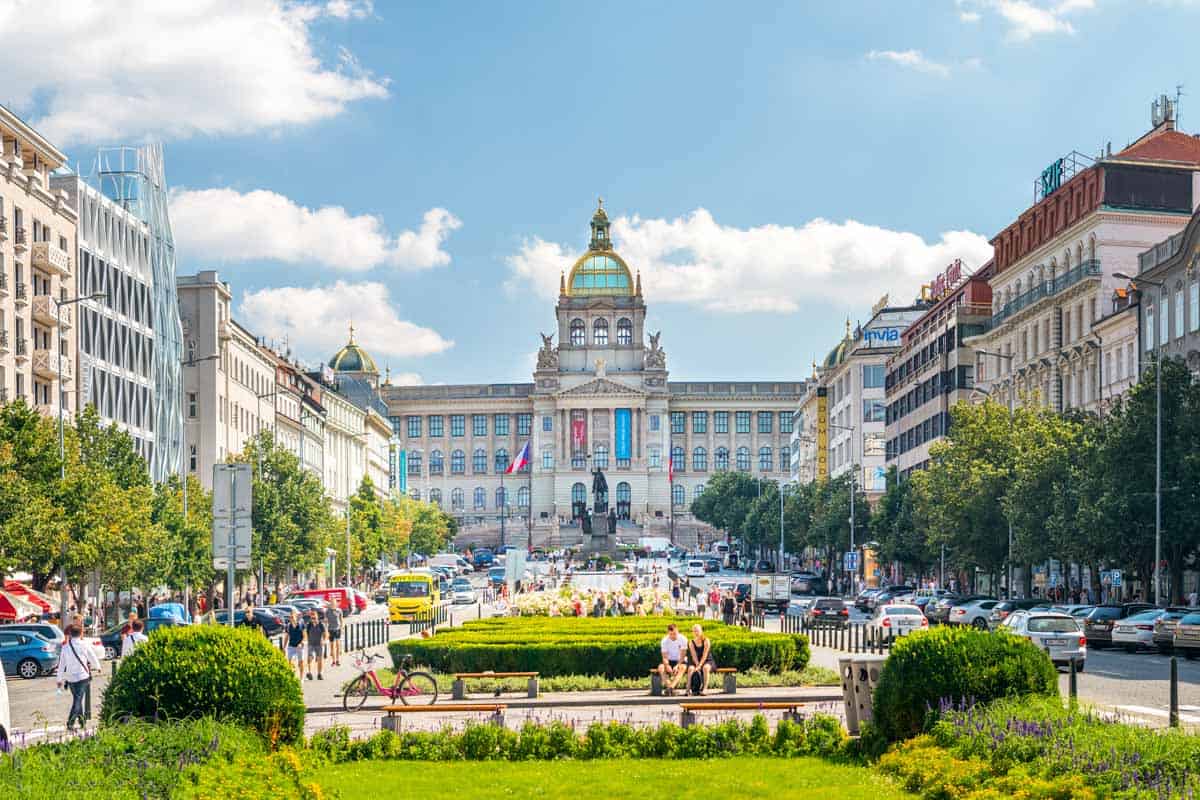
Charles IV first created it in the mid-14th century as a horse market in the New Town. Today, the St. Wenceslas Monument stands atop the boulevard, with the National Museum in the background.
Even though the square is old, the buildings lining its street are not. The oldest dates back to the 18th century, and the others are much younger. Here, you’ll find gorgeous buildings of Art Nouveau, Neo-Renaissance, Socialist Realism, and ultra-modernism.

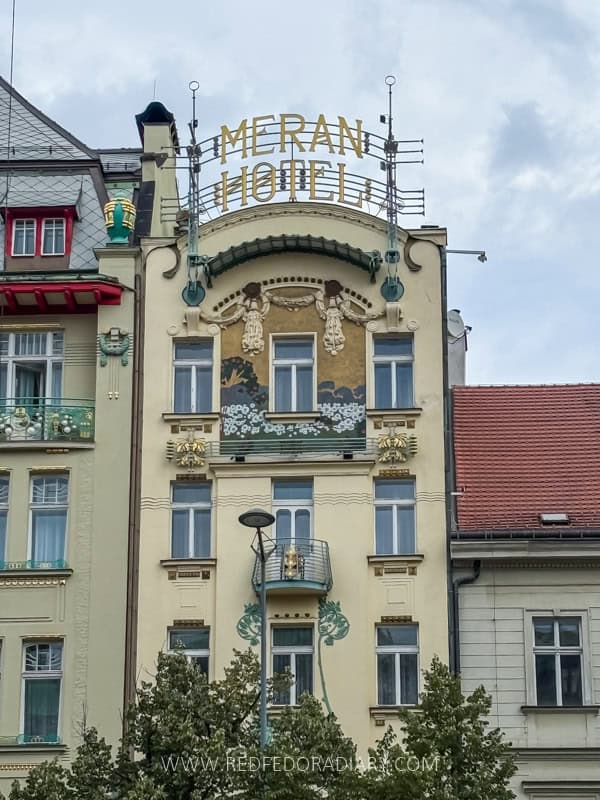
The square is also home to various shops, arcades, clubs, and theaters built during the early-20th-century commercial boom. While walking down towards Old Town Square, pay attention to Wiehl House and the Grand Hotel Europa for their impressive facades.
Upside-Down Statue of St. Wenceslas
The Art Deco-style Lucerna Palace hides a rather interesting sculpture of St. Wenceslas. Called King Wenceslas Riding on a Dead Horse, the monument is the work of the famous Czech sculptor David Černý. Some consider it a parody of a statue in front of the National Museum, while others see it as an attack on Vaclav Klaus, President of the Czech Republic.

However, Černý never comments on this work; he does not need to. If you see something extraordinary on your trip to Prague, like an old Soviet tank painted pink floating on the Vltava, then you are a witness to Černys, another creation. Some of his other permanent art is also included in this walking tour of Prague.
Plan Your Trip Like A Pro
The Powder Tower
Once you finish walking down Wenceslas Square, turn onto Na Prikope Street to walk to the Powder Tower or Prašná Brána. This imposing Gothic tower is one of the original 13 city gates. It was intended to be a nice-looking city entrance as an alternative to a defensive tower. The name comes from when the city initials used it to store gunpowder.
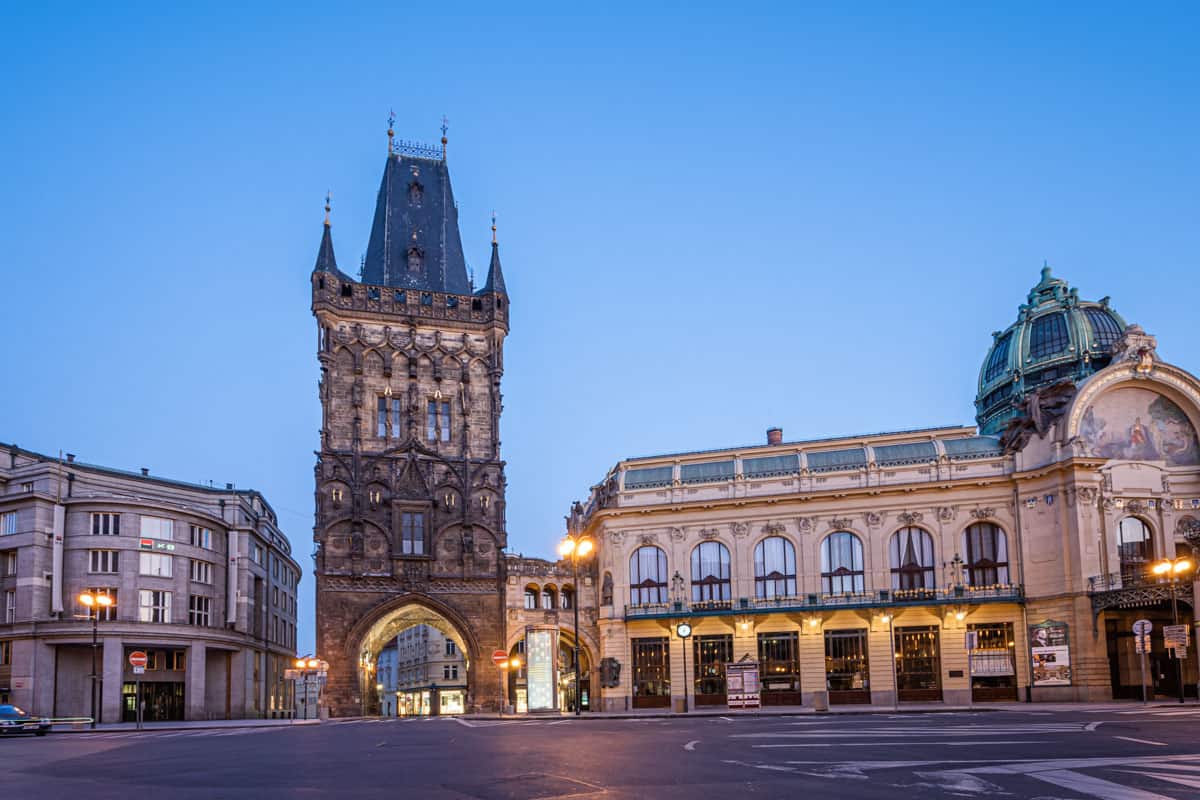
It was also used for the coronation ceremonies, during which the Kings of Prague would walk through it and follow the streets leading to Prague Castle. It was rebuilt in the 19th century after being destroyed during the Prussian siege of 1757.
If you are up for a walk on a few dozen narrow stairs, you can go up to its viewing deck for some spectacular city views.
Right behind the tower is a breathtaking Municipal Hall to check out. And if you fancy a classical music concert, you can attend one here.
Astronomical Clock
From the Powder Tower, continue your walk on Celetná Street, one of the oldest streets in Prague, leading to the Old Town Square, or Staroměstské námesti. We’ll come back to the area at the end of this route, so instead, continue walking until you reach the Astronomical Clock.
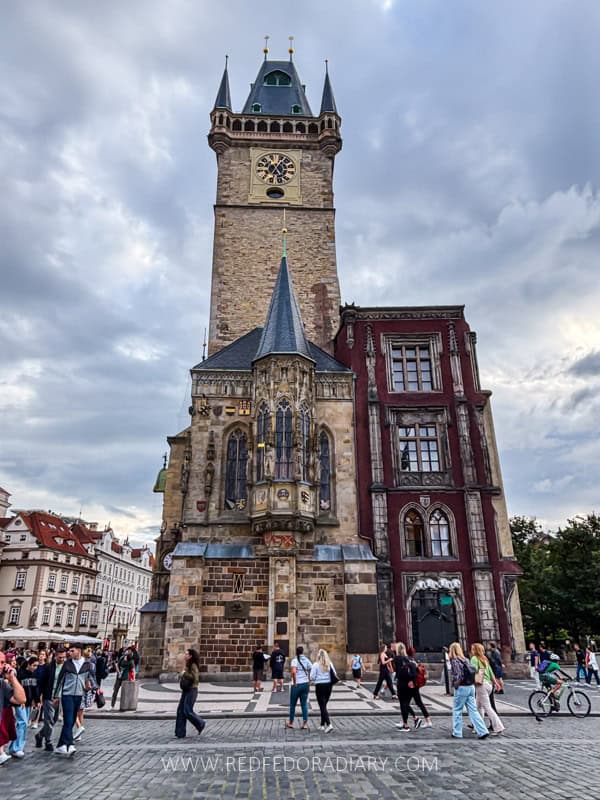
Orloj, in Czech, is a medieval clock installed in 1410. It is considered the third-oldest clock in the world and the oldest one that still works. The clock, built by Mikuláš Kadaň, a clockmaker, and Jan Šindel, an astronomer, attracts hundreds of tourists each hour (from 9 am to 11 pm) to watch a marvelous mechanical performance of 12 apostles greeting the city, a skeleton ringing a bell, a miser with a purse full of money, a Turk shaking his head, and Vanity looking in a mirror.
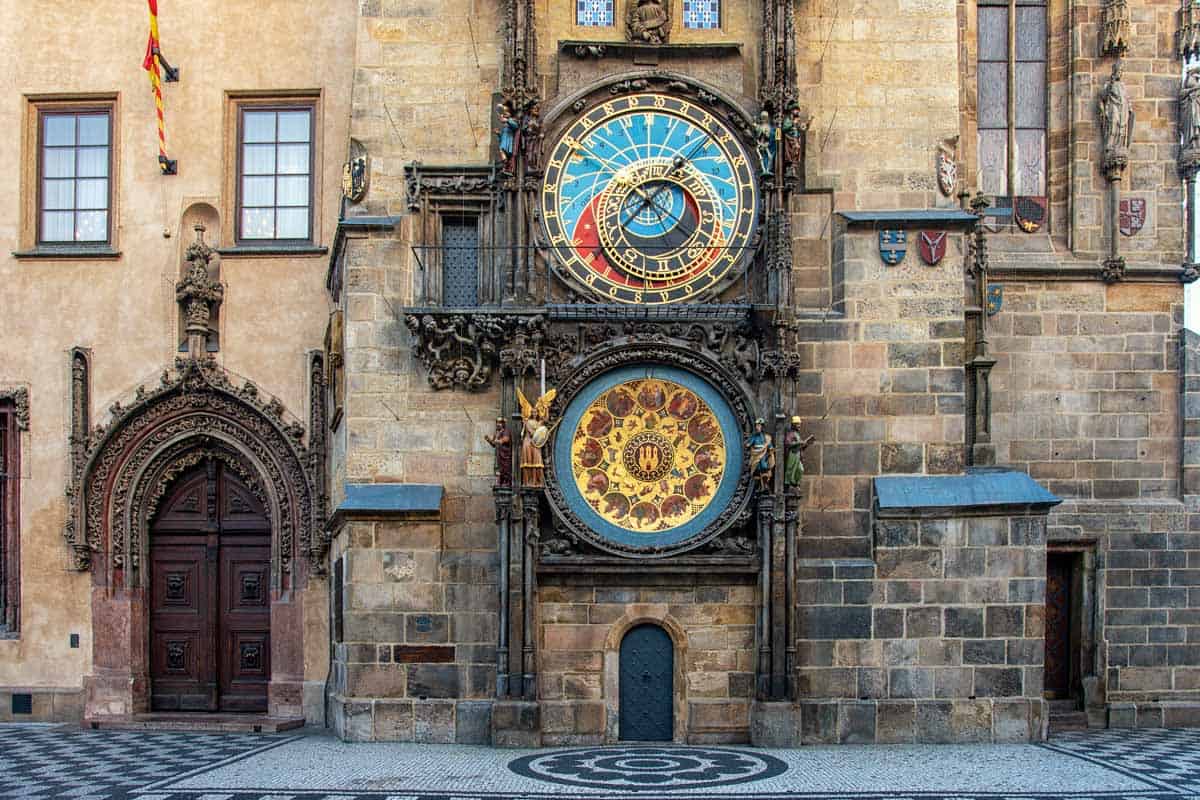
While looking at the clock, you can see the movement of the sun and moon through the signs of the Zodiac. It also tracks Sidereal time, Central European time, and Babylonian time.
If you want to go inside the oldest town hall, buy the skip-the-line ticket in advance. For an additional ticket purchased on the spot, you can see the Gothic chapel and staterooms, and go down to the underground to see the clock’s inner mechanism.
In case you’d prefer a visit with an audio guide and a bit of explanation of the town hall, get this ticket instead.
House of the Minute
The House at the Minute is next to the Astronomical Clock as you walk on Karlova Street.
One of the undoubtedly impressive houses, it was initially a late Gothic building of the 15th century, later renovated in the Renaissance style in the mid-16th century.

White sgraffito (imprints scored into a flat plaster wall to create a three-dimensional effect of depth and shading) decorations on the black background are pretty impressive and tell the story of the Habsburg rulers and scenes from Greek mythology. It also references Renaissance and biblical legends.
Charles Bridge
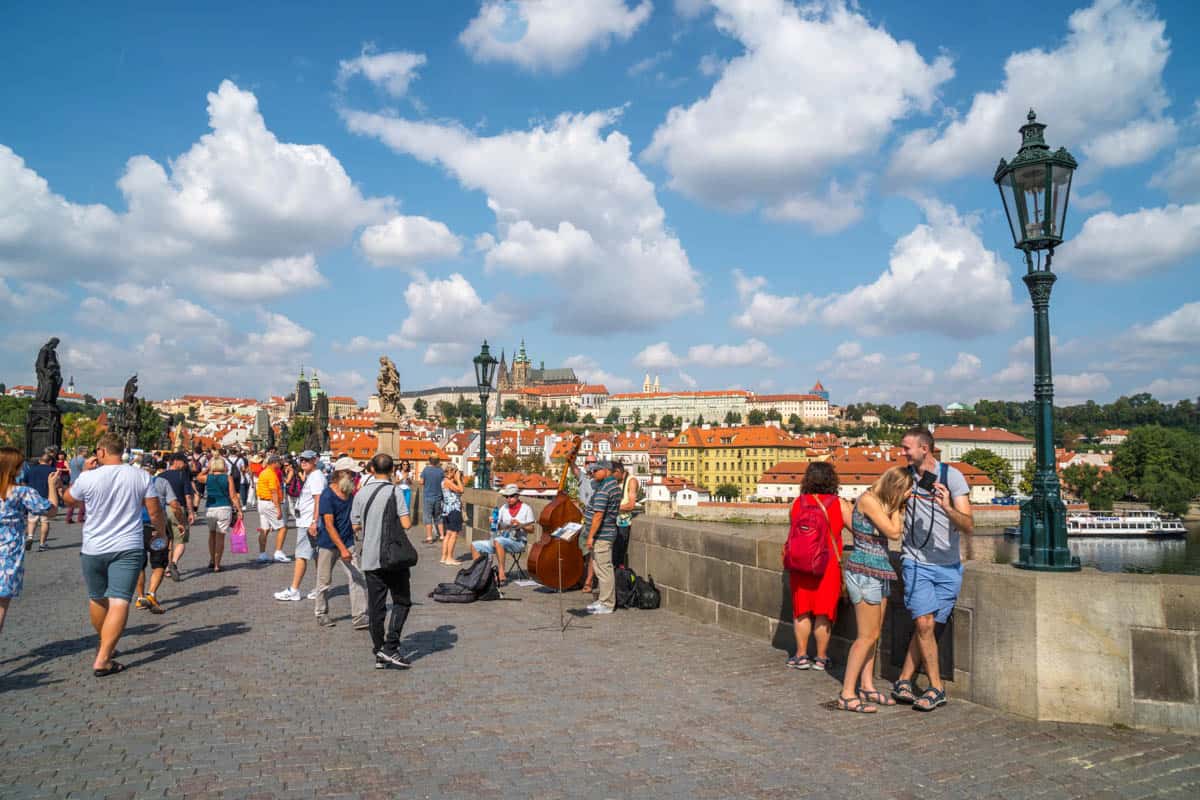
This self-guided, free Prague walking tour continues along Karlova Street again to reach the most famous and spectacular bridge I’ve seen – Karlův Most, or Charles Bridge.
After floods washed away a few wooden bridges and the first stone bridge, Charles IV commissioned a new one in 1357. A 621-meter-long pedestrian Gothic bridge was the only means to cross the Vltava River until 1841; therefore, it was significant in connecting Prague Castle with the Old Town.
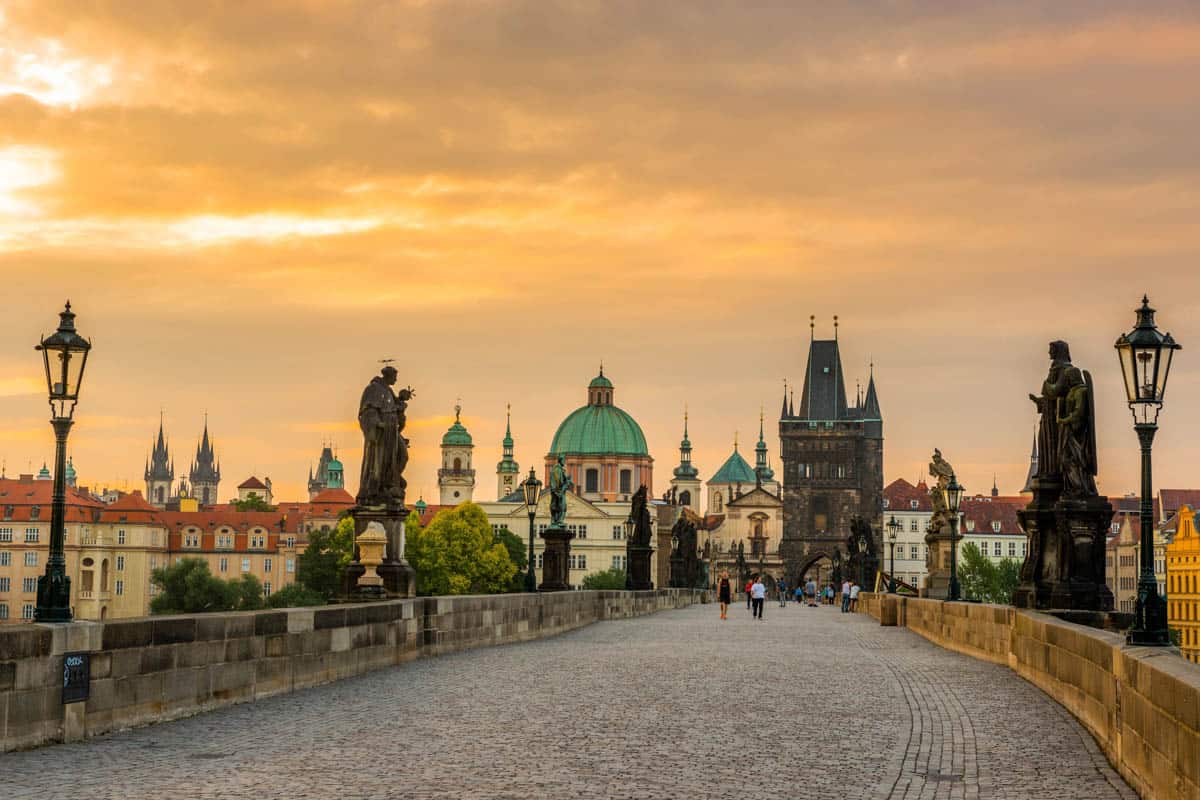
Guarded by three towers, the bridge boasts 30 statues and statuaries, primarily made in Baroque and Gothic styles. For spectacular views of each side of the bridge, you can walk up the stairs of the towers.
The bridge is a top-rated Prague attraction that brings many tourists, local musicians, and souvenir sellers throughout the day. It is equally beautiful both at sunrise and at sunset.
Urinating sculpture
If you love the artwork, I have included a few stops along this free walking tour in Prague, and the next stop is another impressive sculpture by David Cerny. He is known for creating eye-catching, highly controversial, and humorous artwork.
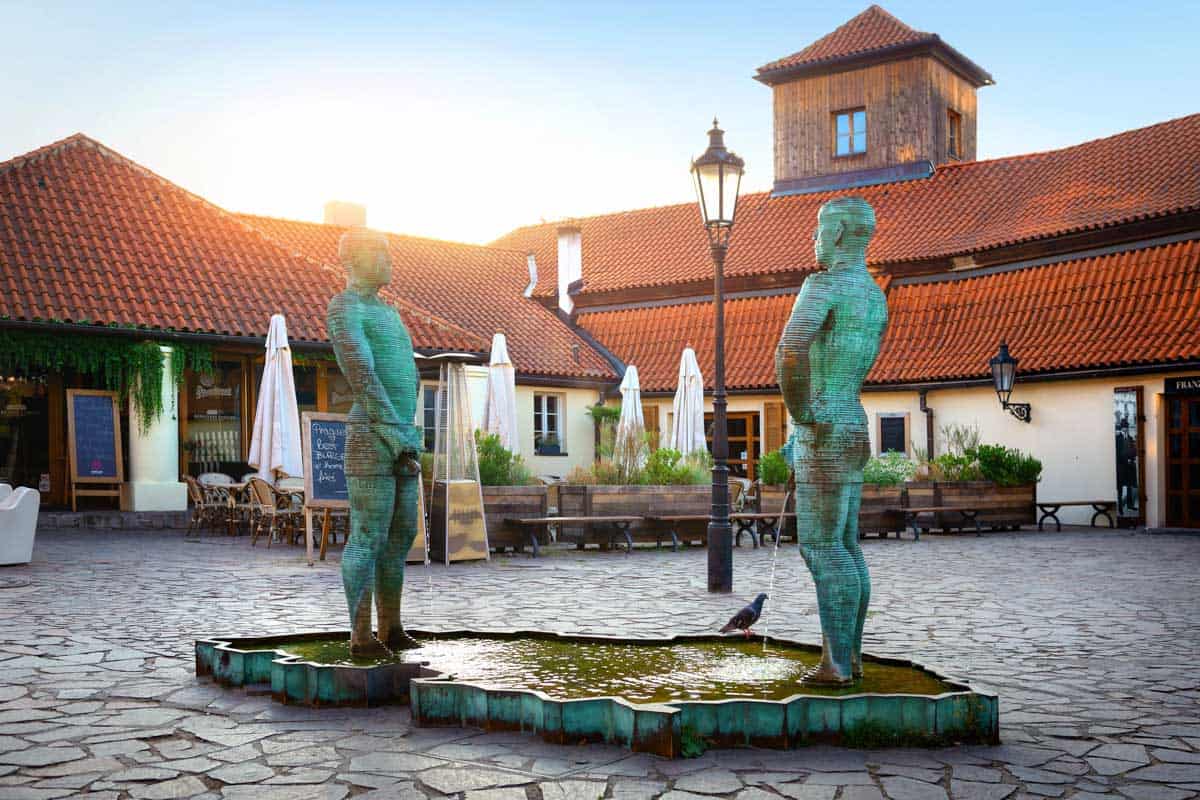
The Piss sculpture, close to the Franz Kafka museum, features two mechanical naked men taking a poss into a pool that resembles the shape of the Czech Republic. It indeed is one of the quirkiest yet thought-provoking attractions in Prague.
Once you are here, remember to walk Prague’s narrowest alley between two buildings. It has a traffic light indicating when you can walk through.
Kampa Island with crawling babies
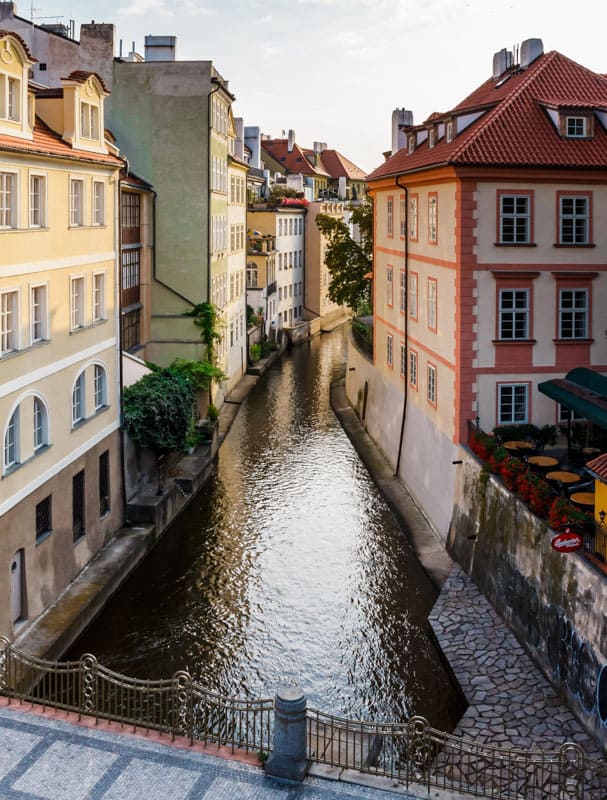
Kampa Island was one of my favorite places to walk around when I was in the neighborhood. It is the largest of the Vltava’s islands, featuring cafés, a serene riverside park, old mills, and a playground. I would bring a blanket and enjoy a peaceful time reading a book, studying, or simply relaxing and watching people walk by.
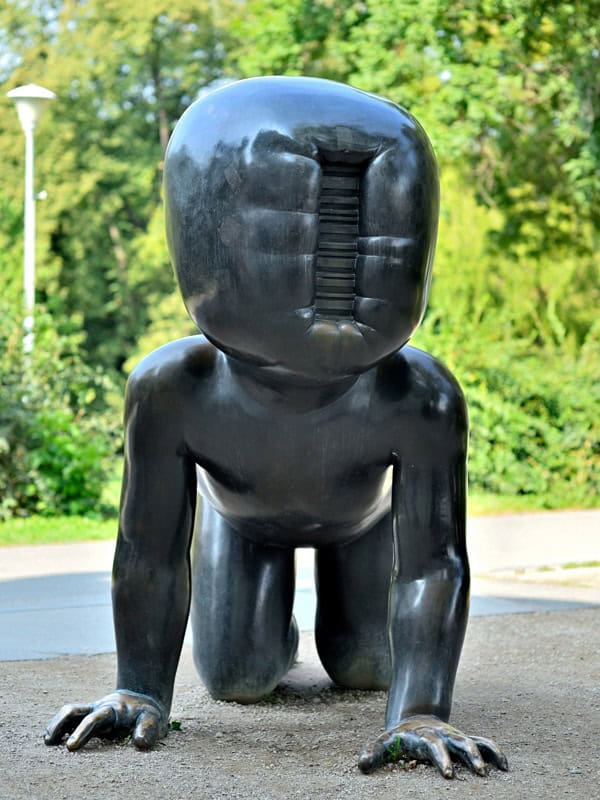
The iconic sight of Kampa Park is another masterpiece of David Cerny – three giant and faceless crawling babies you can climb on and take photos of. They are part of Cerny’s “Babies” project, another excellent example of them as they crawl up the Zizkov TV Tower. So, if you have time on your Prague itinerary, I recommend seeing it, too.
Lennon Wall
Any guided or free walking tour of Prague is incomplete without a visit to John Lennon’s Wall, a symbol of freedom, peace, and love. The wall has different lyrics of Beatles songs or other forms of graffiti, making it an attractive spot for visitors.

The whole concept began in 1988 among youngsters to express their views on the communist regime. The authorities repainted the wall; however, the activists did not back down and redrew the poems the next day.
The wall is always changing, and the original portrait of Lennon is long lost. However, it contains various tags, writings, or drawings. And if you bring a marker, you can also put something on the wall.
St. Nicholas Church
A Baroque church built between 1704 and 1755, St. Nicholas Church is a stunning place of worship and a must-visit attraction in Prague.
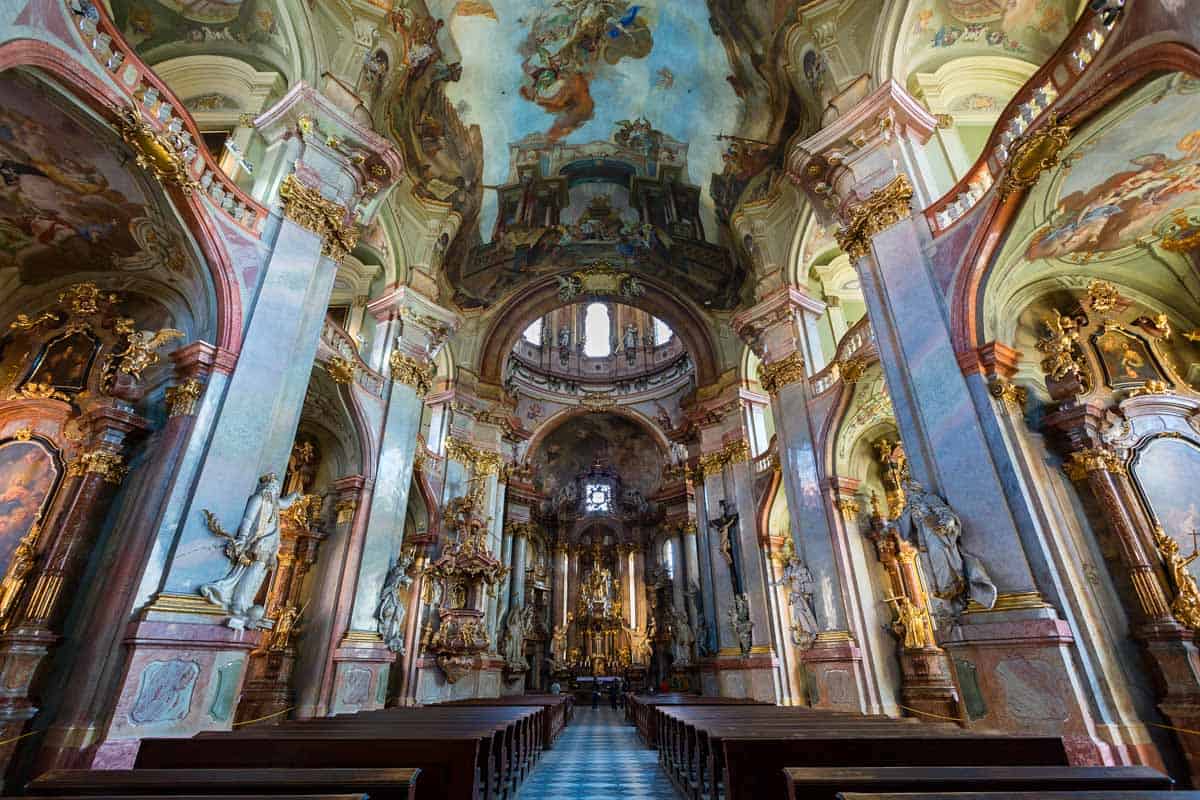
Inspired by the chapel of St. Louis-des-Invalides in Paris, the church’s interior is breathtaking, while its characteristic giant green dome and tower dominating the skyline are visible from afar. You’ll see beautiful frescoes on its ceiling showing biblical scenes.
- Opening hours: vary by month and day, check it here.
- Entrance fee: adults – 150 CZK
Nerudova Street
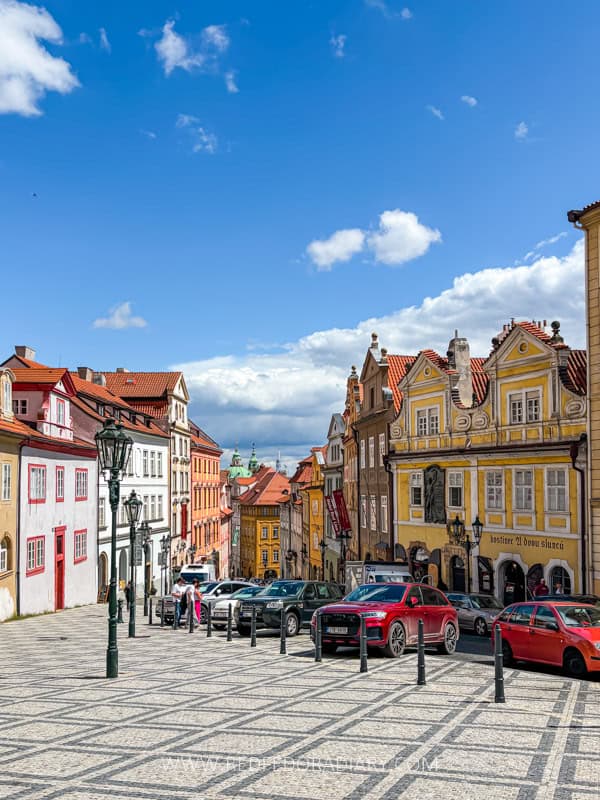
After a visit to the church, continue on via the narrow Nerudova Street, lined with many colorful houses and eventually leading to Prague Castle.
Named after the Czech author Jan Neruda, whose birthplace and the setting of many of his stories, the street was the final stretch of the Royal Route along which the kings walked in their processions to be crowned at the castle.
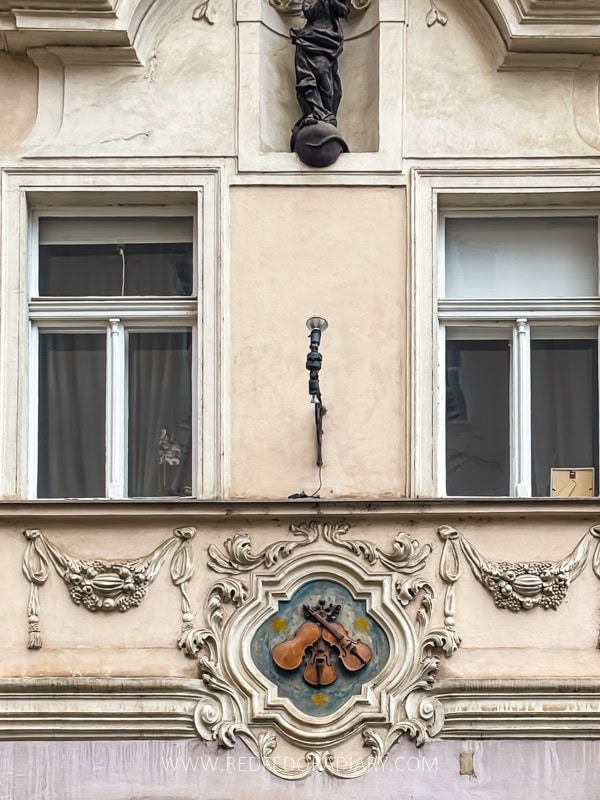
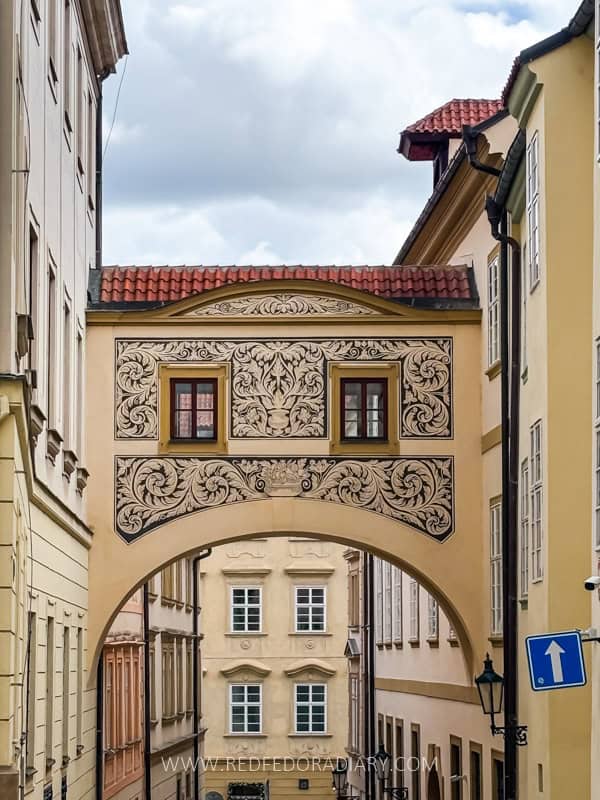
What distinguishes Nerudova is that the buildings here have emblems to differentiate them from one another, before street numbers were introduced in the city.
As you walk up, make sure you look at the following houses: the Red Eagle at No. 6, the House of the Red Lamb at No. 11, the Three Fiddles at No. 12, the Golden Horseshoe at No. 34, the Green Lobster at No. 43, and the White Swan at No. 49.
Have your eyes pierced for a few stunning Baroque buildings at No.5 and 20, while further up at No.33 is a Rococo house.
Schwarzenberg Palace
The next stop on this Prague free walking tour is the most distinctive Schwarzenberg Palace on Hradčany Square. The sgraffito on the surface makes this Renaissance palace easy to notice.
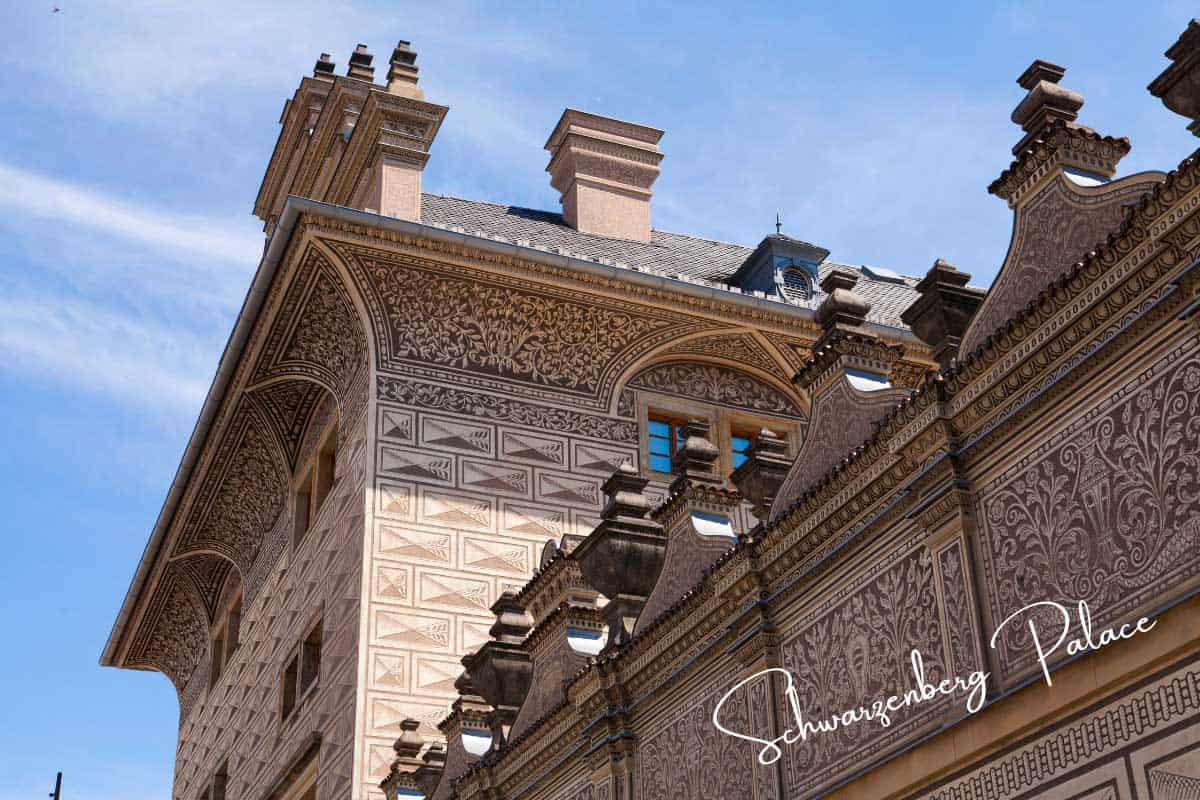
An Italian architect built it for the Lobkowicz Family in the mid-1500s in Florentine style. The Schwarzenbergs, the leading family in the Habsburg Empire, acquired the palace by marriage in 1719. Today, it houses the National Gallery’s exhibition of Baroque art.
Prague Castle Complex
Perched on top of Castle Hill, the stunning Pražský hrad, or Prague Castle, dominates the skyline like no other building. It is the largest coherent castle complex in the world, covering an area of almost 70,000 sq. meters.
The complex, listed as a UNESCO World Heritage Site, features large-scale palaces and ecclesiastical buildings, including four palaces, four churches, marvelous gardens, and a defensive tower, all done in different architectural styles.
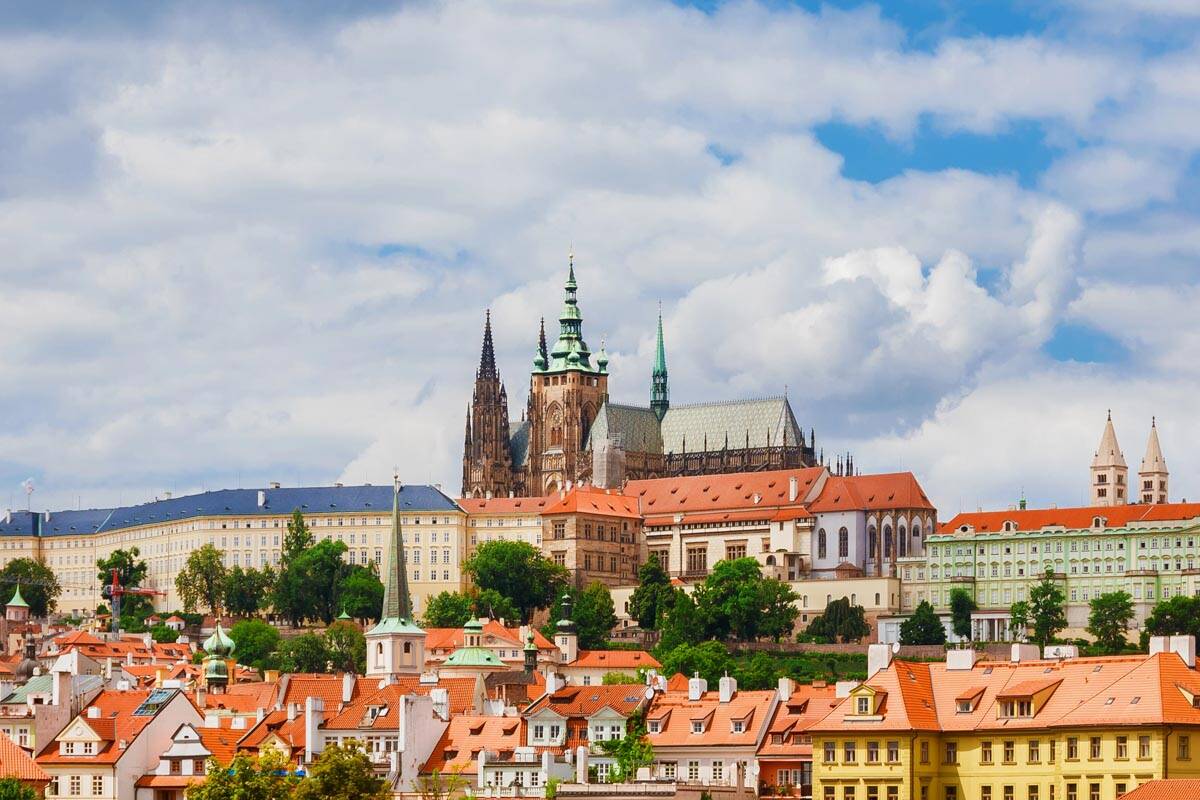
By the beginning of the 14th century, the complex was home to the royal palace, churches, and a monastery. Reconstructed during the rule of Charles IV, it was destroyed by fire in 1541, and later, most of the buildings were renovated in Renaissance style. Since 1918, the castle has been the residence of the President of Czechia.
You can wander the castle grounds free from 6 am to 10 pm, but many landmarks have different opening hours, and some require an entrance ticket.
Please note that I deliberately haven’t included the most important buildings of the Prague Castle complex as separate listings in this post. Instead, I briefly explain their significance here and have included them as separate spots for easy navigation on the Prague walking tour map above.
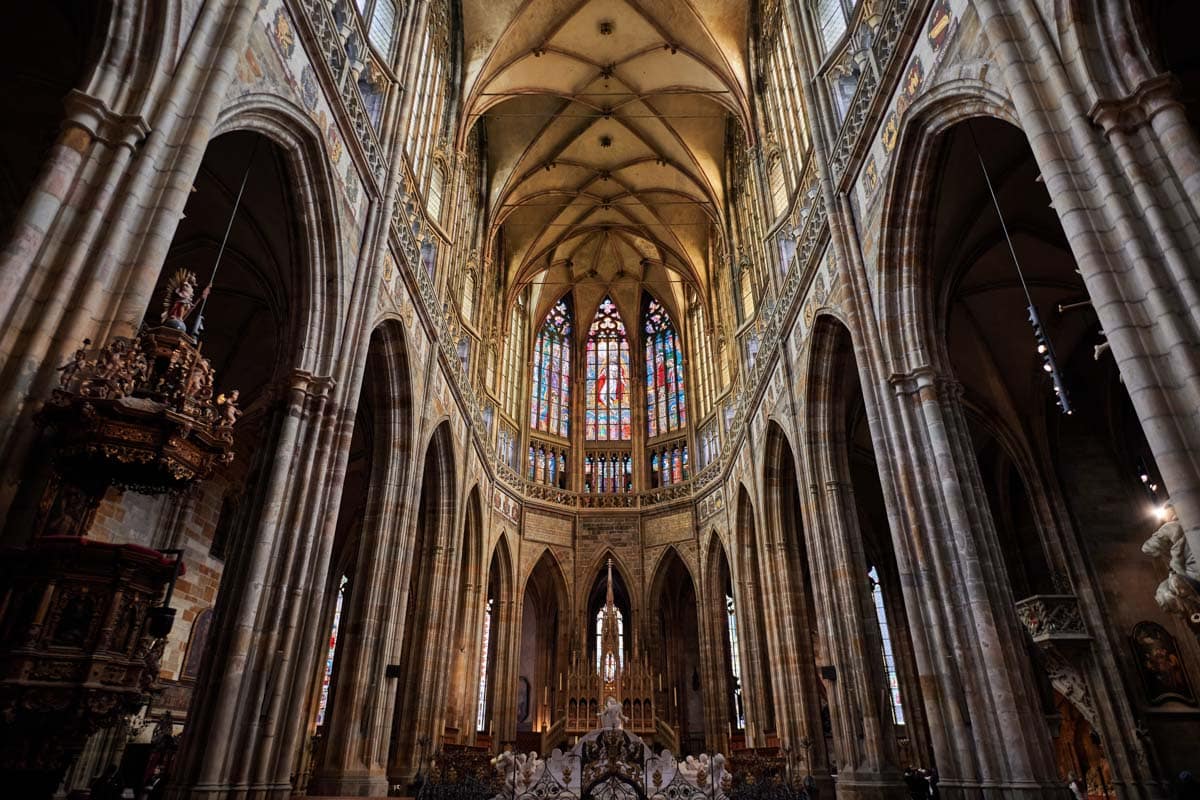
The Gothic St. Vitus Cathedral is the castle’s prominent landmark; it was once the site of kings’ coronations and is also home to the Bohemian Crown Jewels, hidden in a dedicated room. Another noteworthy spot here is the St. George’s Basilica, founded in the early 10th century and believed to be the oldest surviving church in Prague. Its red Baroque facade makes it easy to recognize.
Besides, the complex boasts a unique small street called Golden Lane, lined with colorfully painted historical buildings. Despite its name, don’t expect to find gold-plated pavements or golden decorations here. It got its name after a goldsmith moved into one of the houses in the 17th century.
The lane was also home to Franz Kafka’s sister, who rented house No.22 in 1916, which Kafka himself used for one year to write one of his books. Nobel prize-winning poet Jaroslav Seifert also lived on Golden Lane in 1984.
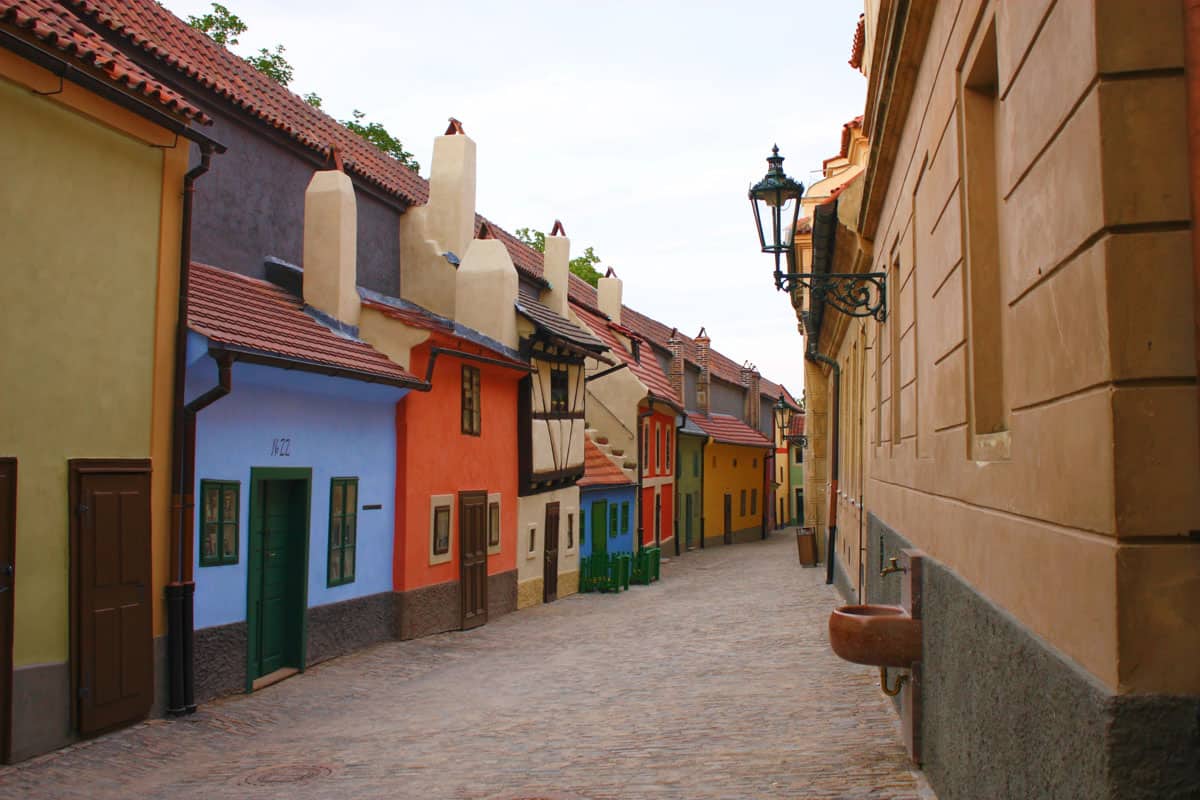
Today, these houses are turned into shops and a museum that displays medieval armor, clothing, and torture devices.
I suggest spending a reasonable amount of time exploring the complex grounds and enjoying panoramic city views from several viewpoints.
Recommended tours of the Prague Castle:
Wallenstein Palace & Gardens
The Wallenstein Palace, one of Prague’s first and largest Baroque palaces, is an ambitious project of the military commander Albrecht von Wallenstein, who decided to build the palace in 1642 to overshadow other landmarks, including the Prague Castle, to show his status as a commander of the Imperial Catholic armies during the Thirty Years’ War.
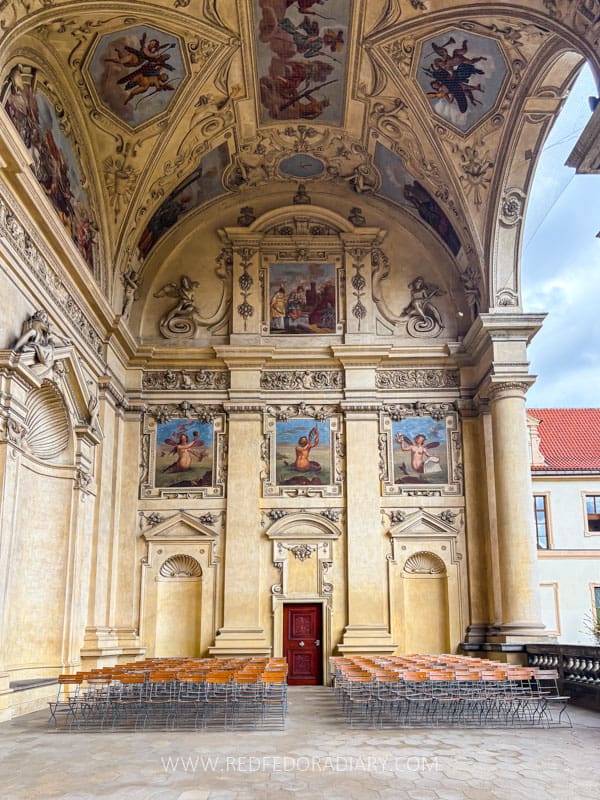

To fulfill the project, he had to buy, destroy, and confiscate a brick kiln factory, three gardens, and many residential houses in the densely populated Lesser Town to give space for his palace.
Nevertheless, it is absolutely stunning once you walk through the palace garden featuring monumental statues and fountains. It is wonderful during spring and summer when flowers bloom.
- Opening hours: the palace garden is open from April to October. Mon-Fri from 7 am to 7 pm and Sat-Sun from 9 am to 7 pm. The palace is open on Saturdays only from April to October from 9 am to 4 pm.
- Entrance fee: FREE for both the garden and the palace.
Rudolfinum
When done exploring the palace gardens, walk towards the Manes Bridge to cross it and slowly go back to the Old Town. One of the first buildings you’ll notice after the bridge is Rudolfinum – one of the most important buildings with several concert halls and home to the Czech Philharmonic Orchestra. This late 19th-century building hosts various concerts, including the Prague Spring International Music Festival.
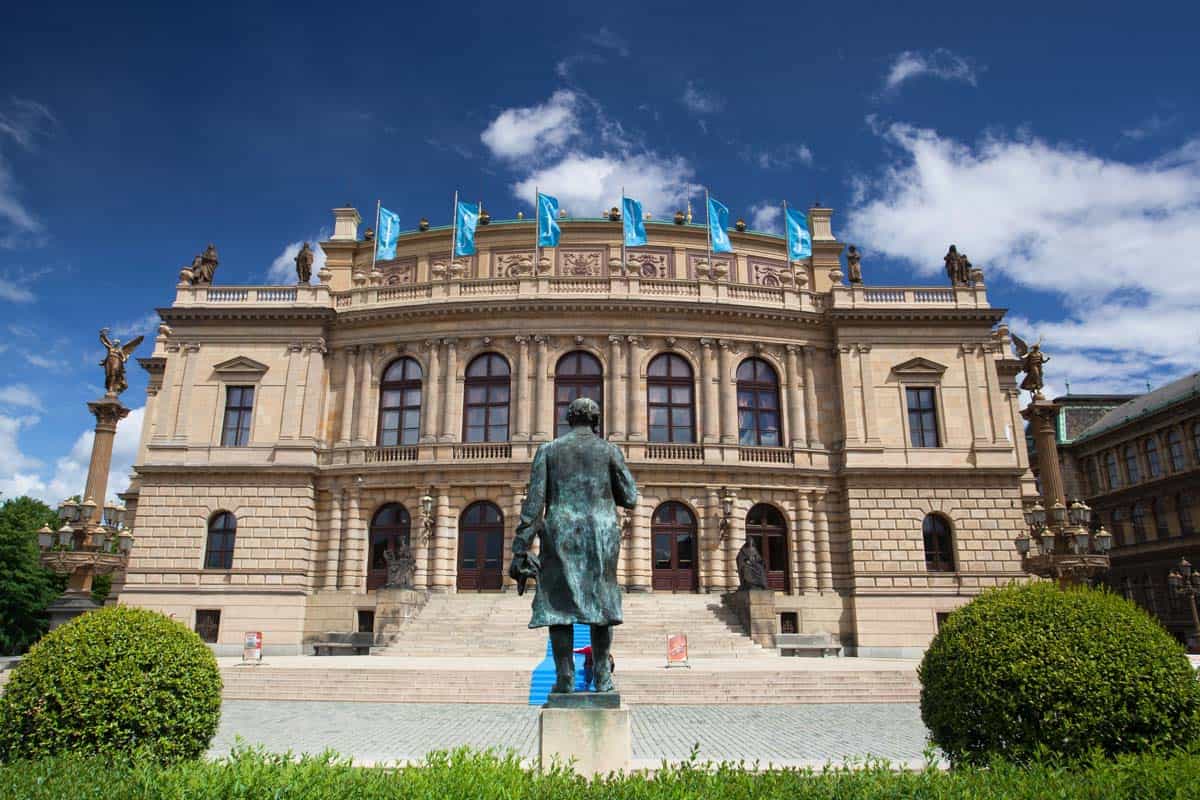
One interesting fact about Rudolfinum is that from 1918 to 1939, and for a short period after WWII, it housed the parliament of Czechoslovakia.
Josefov – Jewish Quarter
The former Jewish ghetto of Prague, Josefov, lies in Old Town. Besides being a reminder of the sad past, it is also one of the city’s upscale areas, with Parizska Street housing some of the most fashionable designer stores.
The Quarter has six synagogues, a ceremonial hall, and an old cemetery. All of the landmarks of the area are within a few minutes’ walk from each other, enabling you to easily walk around to visit the museums or admire the beautiful architecture of these synagogues. Surprisingly, the area even survived the Nazi occupation as Hitler himself decided to save it as a “Museum of an Extinct Race.”

Similar to the Prague Castle section, I haven’t included these synagogues and museums as separate listings in this post. Instead, I summarize the importance of each building and have placed the pins in the map listed above.
Pinkas Synagogue is the second-oldest synagogue in Prague, from the 1500s, and has been restored countless times over the centuries.
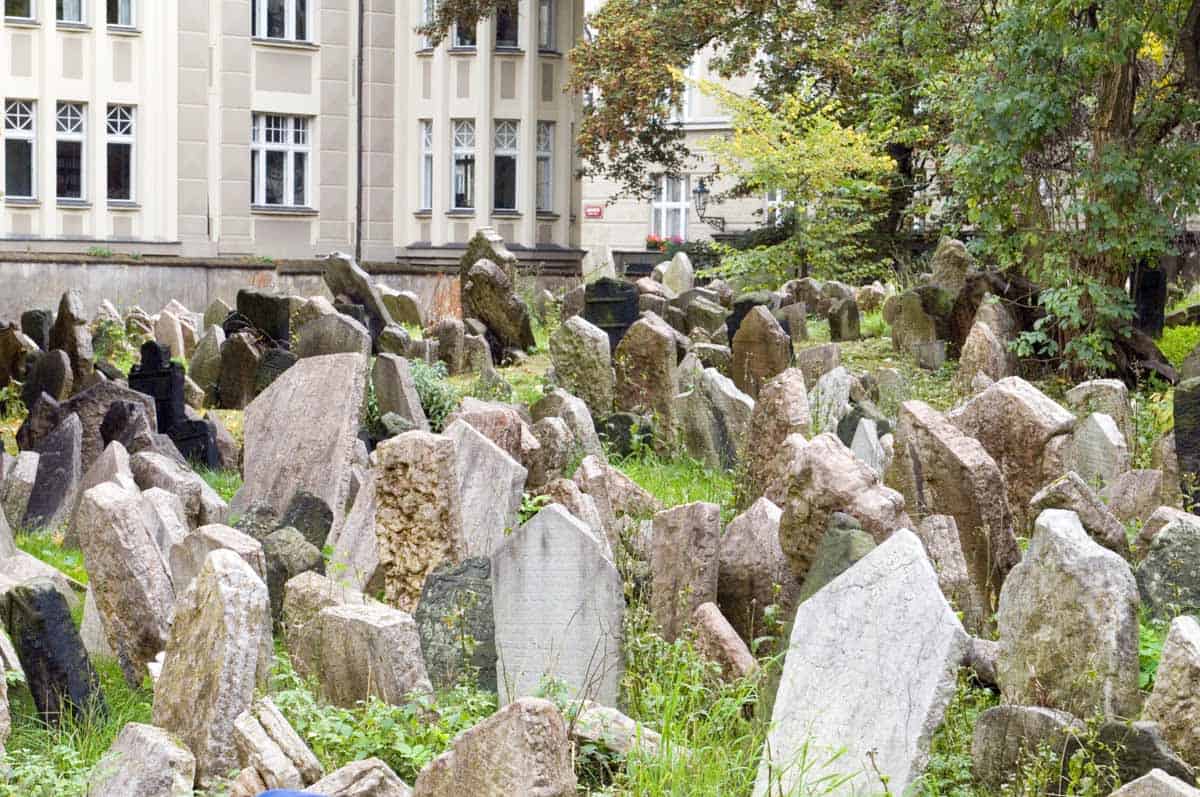
Old Jewish Cemetery is another must-visit Prague attraction because it is the oldest surviving Jewish burial ground in the city, dating back to the mid-15th century. Back then, the laws prohibited local Jews from burying the dead outside of the ghetto, which obviously resulted in cramped and overcrowded gravestones that are eerie, surreal, and mindblowing to see. Around 12,000 tombstones are visible, but about 100,000 bodies are estimated to be buried beneath them, stacked in up to 12 layers.


Klausen Synagogue was established by Mordechai Maisel, a that-time Mayor of the Jewish Quarter, at the turn of the 17th century. It was constructed on the site of the former Jewish school and a small prayer house.
The Old-New Synagogue is another noteworthy spot on this route, standing as the oldest surviving synagogue in Europe. The synagogue, built in approximately 1270, managed to endure many fires, Jewish massacres, destruction of the ghetto, and even the Nazi occupation.
Spanish Synagogue is the city’s newest Jewish religious building, constructed in 1868. The ornate facade, with its horseshoe arches, pseudo-minarets, and columns, is gorgeous. Inside, the pseudo-Moorish design deliberately mirrors the Spanish Alhambra and contrasts with the other, simpler synagogues of the Quarter.
Maisel Synagogue, built in Neo-Gothic style, was constructed at the end of the 16th century as a private prayer house for the Mordechai Maisel family, who got wealthy by lending money to Emperor Rudolph II to aid the wars against the Turks. He used the profits to develop and invest in the Jewish Quarter.
Apparently, the original synagogue was the most ornate of them all and, sadly, was destroyed by fire in 1689. It was then rebuilt to its current state at the beginning of the 20th century. Today, it houses an exhibition about the history of the Jewish community in the Czech Republic, documenting their lives here from the 10th to the 18th century.
The Quarter is now part of the Jewish Museum in Prague and requires entrance tickets to the synagogues, museums, and the cemetery.
- Opening hours: every day, except Saturdays and Jewish Holidays. More info.
- Entrance fee: adults – 500 CZK gives you access to all the Prague Jewish Town attractions and is valid for three days.
Recommended tours in the Prague Jewish Quarter:
Kafka Monument
Franz Kafka, the famous novelist and short-story writer, was born in Prague, primarily in the Old Town and its Jewish Quarter, to a German-Jewish mother and a Czech-Jewish father.
Because of his German and Czech parents, he was rarely accepted by either nationality and often lived in isolation and fear; most of his works were not published in his lifetime.
Ironically, as Kafka became world-famous, Prague now has his face on mugs, magnets, postcards, T-shirts, and other souvenirs.
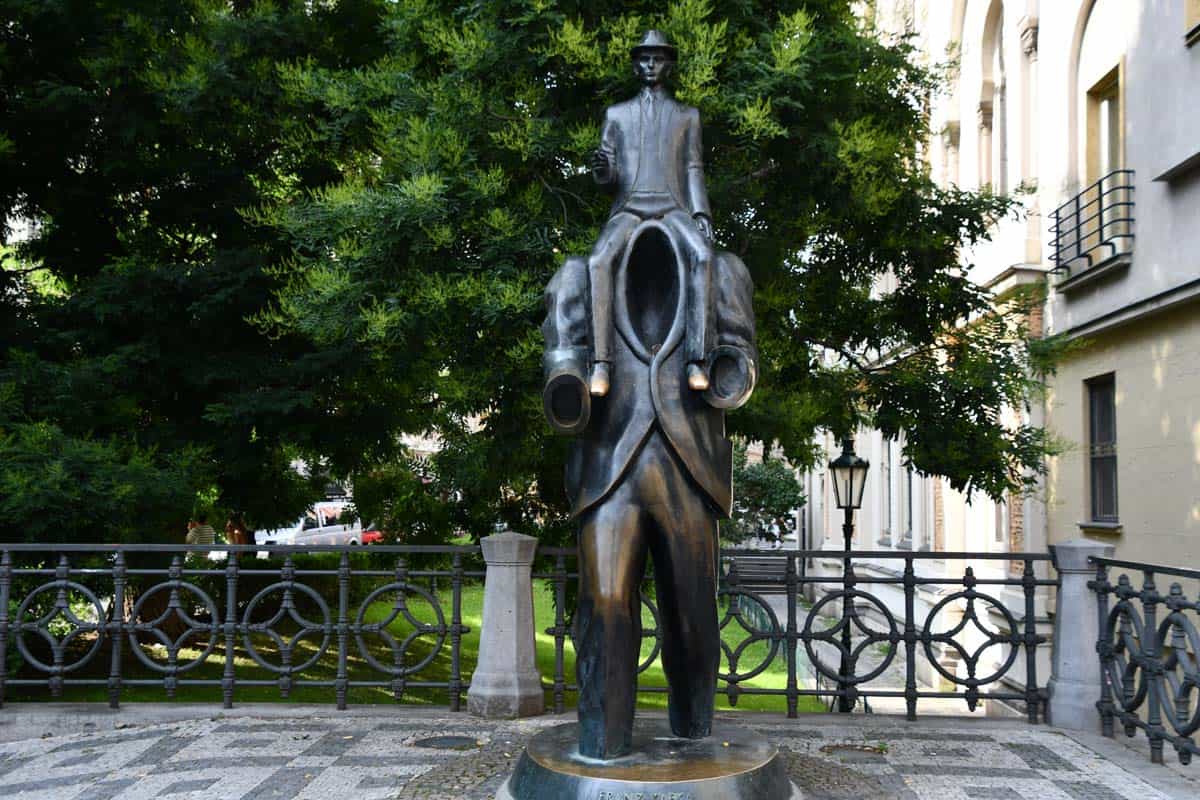
The monument honoring him, located a few minutes from the synagogues, is one of the most bizarre sculptures you might see in Prague. It depicts Kafka sitting on the shoulders of a headless figure, likely himself, and references his 1912 story Description of a Struggle.
Old Town Square
Following the fancy Parizska Street lined with luxury designer stores, you’ll return to Prague’s historic square.
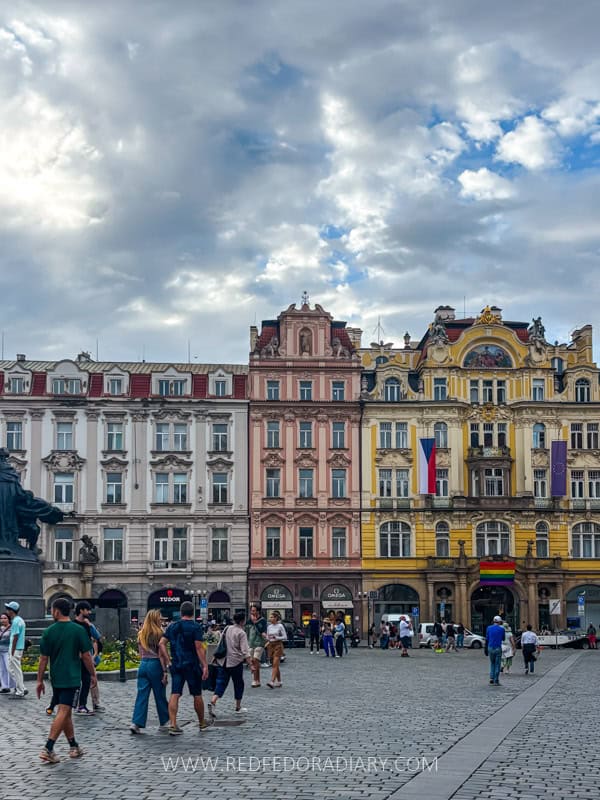
Take some time now to wander around admiring the beautiful pastel-colored buildings of different architectural styles, such as Art Nouveau, Baroque, Gothic, Rococo, and Renaissance.
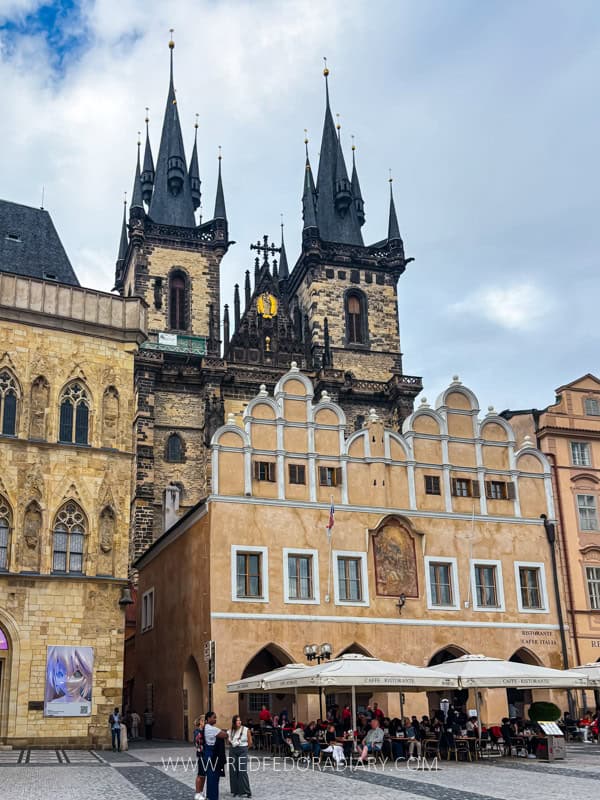

Storch House, at number 16 south of the square, also known as the House of the Stone Madonna, has one of the most stunning painted exteriors. The Kinský Palace to the east is another noteworthy building with a white-and-pink stuccoed Rococo facade that today houses the National Gallery’s exhibition.
Make sure to visit the Gothic Church of Our Lady before Týn, which dominates the skyline of Old Town Square. This 15th-century church has towers that rise 80 meters; if you look closely, you’ll see they’re not identical.
Besides historical buildings, the square is lined with various museums, restaurants, and souvenir shops for you to pop into.
You must be hungry after that walk, right? Take a look at the must-visit restaurants for food lovers in Prague
Guided Prague walking tours
If you want to avoid the hassle of this tour and prefer to join guided walking tours in Prague to learn more about the history and culture of the city, here are a few recommended ones:
Complete Prague Free Tour (Old Town, Lesser Town & Jewish Quarter) – cover Prague’s main historic districts in one extended free walking tour. Explore Old Town Square, admire the Astronomical Clock, walk across Charles Bridge, and continue through the Jewish Quarter while getting a solid overview of the city’s past.
Old Town & Jewish Quarter Free Walking Tour – dive into Prague’s history through stories and key figures while walking through Old Town and the Jewish Quarter. See highlights like the Astronomical Clock and Charles University, and finish at Bethlehem Square after tracing the city’s development from its early days onward.
A 3-Hour Walking Tour of Old Town & Prague Castle takes you from the historic Old Town to Prague Castle, led by professional local guides who share interesting stories and legends.
Alternative Prague Walking Tour is great for those who prefer to see a different side of the city that passes through cool Prague neighborhoods, street art, and underground subcultures.
Prague Ghosts and Legends Walking Tour is an evening tour that lasts from 1:30 to 2 hours, where you walk through haunted streets and listen to mysterious stories of medieval Prague.
The Old Town and Jewish Quarter Guided Walking Tour takes you through the Jewish Quarter, where you can hear the history of Prague’s Jewish community and see its synagogues and cemetery.
Old Town, Medieval Underground & Dungeon Tour is ideal for those who’d love to see what is hidden below the Old Town with its rooms, cellars, and corridors.
Prague travel tips
Get travel insurance
First thing I do when I finalize my plans is to buy travel insurance! No one expects things to go wrong during a trip, but delays, lost luggage, or sudden health issues can happen when you least expect them.
That’s why I always recommend having travel insurance—it helps cover unexpected costs and avoids dealing with large bills while you’re abroad.
I personally use Heymondo travel insurance whenever I travel, and the link here already includes a 5% discount applied automatically.
Where to stay in Prague
Prague offers a variety of neighborhoods and areas to stay in, depending on your preferences and budget. Old Town and New Town are ideal for staying close to the city’s major attractions and offer plenty of accommodation options in central locations, ranging from budget hostels to luxury hotels.
You can easily access landmarks such as Charles Bridge and Old Town Square, which can be a few minutes’ walk from your accommodation.

For a quieter stay, the Mala Strana and Vinohrady neighborhoods offer a more residential feel, with plenty of charming streets and local restaurants to explore. For a more detailed overview of the areas, check out my dedicated post on where to stay in Prague that explains the neighborhoods and lists some of the best hotels in Prague.
Best time to visit Prague
Prague is a beautiful city that offers visitors a rich history, stunning architecture, and a vibrant culture. However, the city’s weather can vary greatly by season, making it essential to plan your trip accordingly.


The best time to visit Prague is in spring and fall, when the weather is mild, and the crowds are smaller. The peak tourist season is summer, from June to August. The season is warm and sunny, bringing crowds of tourists, and hotel prices tend to go high.
Winter is magical and another of the best times to visit Prague, especially around the holidays when the city is decorated with Christmas markets and lights.
However, the weather can be pretty cold, with temperatures ranging from -5 °C to 5°C, and there is a chance of snow. However, snow-covered Prague is absolutely stunning.
What to wear in Prague
Prague is a walkable city with cobblestone streets lining most of its central districts. Therefore, it is essential to know what to wear in Prague based on the weather temperatures and the activities you plan to do.
The weather in Prague can vary greatly by season, so it’s important to pack clothing appropriate for the time of year you plan to visit.
If you plan to visit during the summer, pack lightweight, breathable clothing, such as t-shirts, shorts, flowy skirts, and long dresses. However, bring a light foldable raincoat or umbrella for occasional rain showers.
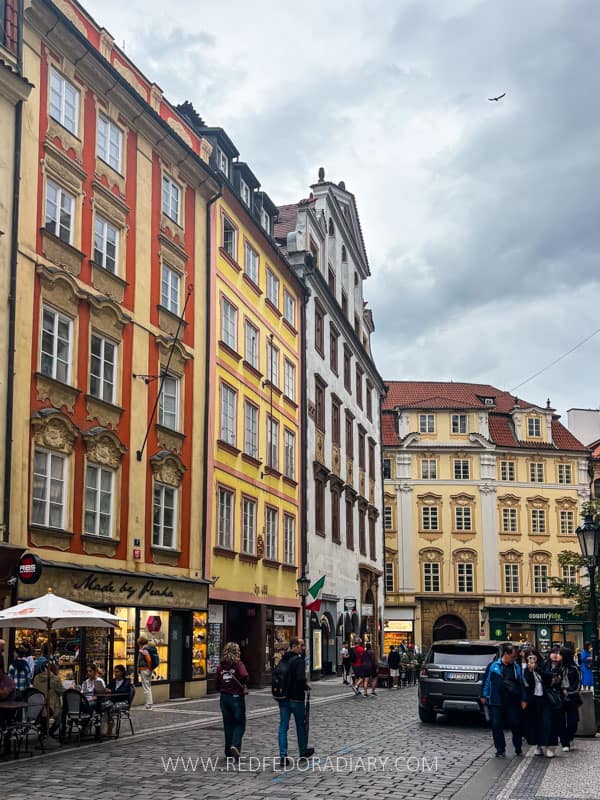
Planning a trip to Prague in spring or autumn and want to know what to wear? In that case, pack layers that will keep you warm during cooler mornings and evenings.
A light coat or jacket, cardigan, or scarf can help you adjust to temperature changes throughout the day.
Winter in Prague is quite cold, with temperatures dropping below freezing, so wear warm clothes like a striped checkered sweater or hoodie and a winter jacket.
Remember a winter hat, scarf, and gloves. I typically opt for thermal leggings and t-shirts for winter travels that I wear underneath jeans and a hoodie.
Since the best way to explore Prague is to wander its streets aimlessly, comfortable footwear is essential year-round. Bring comfortable walking shoes or sneakers that can withstand long days of walking on cobblestone streets.
I always pack my Teva walking shoes and/or The North Face sandals for warmer climates. Bring waterproof winter shoes to navigate through snow and ice if you plan to visit during winter.
Remember to throw in these useful accessories in your bag:
Camera or phone: Prague is an extremely photogenic city, so be sure to bring a camera (I have a Sony a6300) or smartphone (I recently purchased a Google Pixel 7 Lemongrass) to capture all the sights.
Power bank: I am sure you’ll be taking lots of photos and using maps to navigate around. Therefore, having an external charger to keep you on the go is very important. I have this Anker power charger.
Universal adapter: If you are coming from outside Europe, you’ll need a universal adapter to charge your devices.


Get a private transfer from the airport
If you are traveling with a lot of luggage or arriving late at night, consider booking an airport transfer to your hotel.
I’ve been using Welcome Pickups for airport transfers for a while now, and it’s one of the easiest ways to get into the city after a flight. You don’t have to wait in taxi lines, deal with pricing, or worry about unexpected charges.
A driver meets you at arrivals, helps with your luggage, and takes you directly to your accommodation.
Purchase an eSIM
Staying connected while traveling is a game-changer—whether it’s for navigating, booking rides, checking reservations, or just sharing moments on the go.
I’ve been using eSIMs for a few years now, and it’s by far the easiest way to get mobile data abroad without dealing with local SIM cards or expensive roaming. You can buy and activate a data plan in minutes, keep everything prepaid, and still use your original number for calls or SMS if needed.
I usually go with Airalo or Saily (both created by NordVPN), but I’ve also put together a dedicated guide to the best eSIMs for travel, comparing all the providers I’ve personally tested.


Rent a car for day trips
There are some really charming towns close to Prague that are ideal for day trips, and having your own car to visit them is a big plus! When renting a car, I usually compare options on LocalRent and DiscoverCars, depending on the destination and availability.
LocalRent often offers more affordable rates and works directly with local car rental companies, which is great for finding better deals and simpler terms.
DiscoverCars, on the other hand, is a global platform that compares offers from larger international and well-known rental brands. It’s useful if you want more variety, broader coverage, or prefer booking with established companies.
FAQ for Prague walking tour
How much should I tip for a free walking tour in Prague?
Most travelers tip between 200–500 CZK (about 10–20 Euros) per person for a free walking tour in Prague, depending on the quality and length of the tour. Tipping is not required but is appreciated by local guides.
How long does a Prague walking tour take?
This self-guided tour typically takes 4 to 6 hours, depending on your walking pace, how often you stop for photos, museums, coffee breaks, or lunch. If you plan to enter Prague Castle or explore the exhibitions inside, allow for a full day.
Guided walking tours in Prague take around 2:30-3 hours, depending on the tour you book.
Is a self-guided or guided walking tour better in Prague?
Self-guided tours offer flexibility and let you explore at your own pace, while guided tours provide expert commentary, historical context, access to hidden details, and local insights.
What should I wear for a walking tour in Prague?
Wear comfortable walking shoes for cobblestone streets and dress in layers to adapt to changing weather. Bring a raincoat or umbrella, especially in spring and autumn. In summer, light clothing and sun protection are important. In winter, temperatures can drop below freezing.
Is one day enough for Prague?
One day is enough to see Prague’s main landmarks, especially if you follow a well-planned walking route. However, to fully experience neighborhoods, museums, food spots, and hidden courtyards, 2–3 days in Prague is ideal.
What are the must-see stops on a Prague walking tour?
Walking tours in Prague usually focus on specific areas, as the main landmarks are spread across the city. However, longer or more comprehensive tours typically include Old Town Square with the Astronomical Clock, Charles Bridge, and Prague Castle as the key highlights.
Do I need to book a walking tour in advance?
For guided tours, advance booking is recommended, especially in peak season, as popular tours can fill up quickly. Some free tours also require reservations.
Can I join a free walking tour in Prague without booking?
Some free walking tours allow walk-ins, but booking ahead ensures your spot, especially during busy times. Always check the tour provider’s policy.
Are Prague walking tours suitable for families?
Yes, most walking tours in Prague are family-friendly. The route can be adjusted for younger children, and many stops are engaging for all ages. I’d still double-check with the provider.
Are Prague attractions free to visit?
Some areas, such as Old Town Square, Charles Bridge, and parts of the Prague Castle grounds, are free to visit. Museums, towers, and castle interiors require tickets. It’s worth checking bundled ticket options if you plan to visit several paid attractions. Go City Pass gives you up to 50% on top attractions.
When is the best time to do a Prague walking tour?
Spring (April–June) and autumn (September–October) offer mild weather and fewer crowds. Summer is lively but busy, especially around Old Town and Charles Bridge. Winter is colder but atmospheric, particularly during the Christmas market season.
What a great walking (and virtual for now) tour! I love how much you are able to take in in just 6km!!! I will definitely refer back to this if I even make it to Prague.
i would love to visit prague! very high on my bucket list and love this itinerary
Ahh! I can’t stand not knowing the story behind something, now I really want to know about Černý’s Upsidedown statue of St Wenceslas! In any case it’s very interesting and I guess we can all make our own decision about what Černý’s trying to say with it.
Thank you for including a map! This helps a ton when trying to find out where to start! Old Town looks amazing…
I have only heard amazing things about Prague, and I love how you fit in so many things in this day trip! I cannot believe how big Prague Castle is. I can’t imagine exploring a place so large! Seems like there is just so much to do here!
I visited Prague a very long time ago and I would love to go there again! This self walking tour is such a great idea! Super useful, I am saving it for later! Thank you Baia!
Same here, would love to go back sometime soon!
Prague is so lovely!! This is such a great walking guide. I would love to come back and be able to explore more.
Happy you found it useful! 🙂
Simply in love with the photography here- I am a sucker for architecture and Prague has a veritable dose of that.
Hey Shalzmojo, yes the city has gorgeous buildings to admire 🙂
Great post!! Its pretty elaborate and so helpful in anyone willing to take a self-guide walk. Love the pictures also 🙂
Thank you so much! I am glad you found it useful 🙂
I love this idea. There is a lot to see in Prague and it’s easy to miss things so this is so useful and very comprehensive
Definitely! Prague has plenty of things to see and it’s very easy to miss some of them
This is great! I actually recognise some of it from when I wandered around the city myself. It’s an amazing place to be.
What a great walking tour of Prague! I would especially enjoy wandering old town, taking tons of photos of the clock and Charles Bridge! It definitely seems that Prague has a ton of charm and sights to see. 😁
This will be such a handy guide next time I’m in Prague! You really mapped out for us, thanks!
Happy to provide all the details 🙂
I love Prague so much. Easily one of my favorite cities. This is great itinerary, and it gave me a nice walk down memory lane!
Love this! Prague is one of my favourite cities and I can’t wait to visit again one day 🙂 I was lucky to have my friend that lives there show me around when I stayed with her but would like to go back to a few of the spots that I missed!