
Kojori to Asureti Hike: Walk to Georgia’s German Settlement
Tbilisi is more than its rich history, beautiful architecture, and tasty food. It might surprise many, but one can do many hikes near Tbilisi almost year-round. This detailed guide shows how to do a Kojori to Asureti hike with a stop at Korjori Fortress and an optional dinner in Asureti.
Kojori, a small townlet incorporated into the city’s boundaries a few years ago, is an excellent starting point for hiking in Tbilisi. From here, several trails lead back to Tbilisi (via Udzo Monastery and Mtatsminda Mount), Kiketi (another nearby townlet), Asureti (a former German settlement), and Vashlovani village (not the national park).
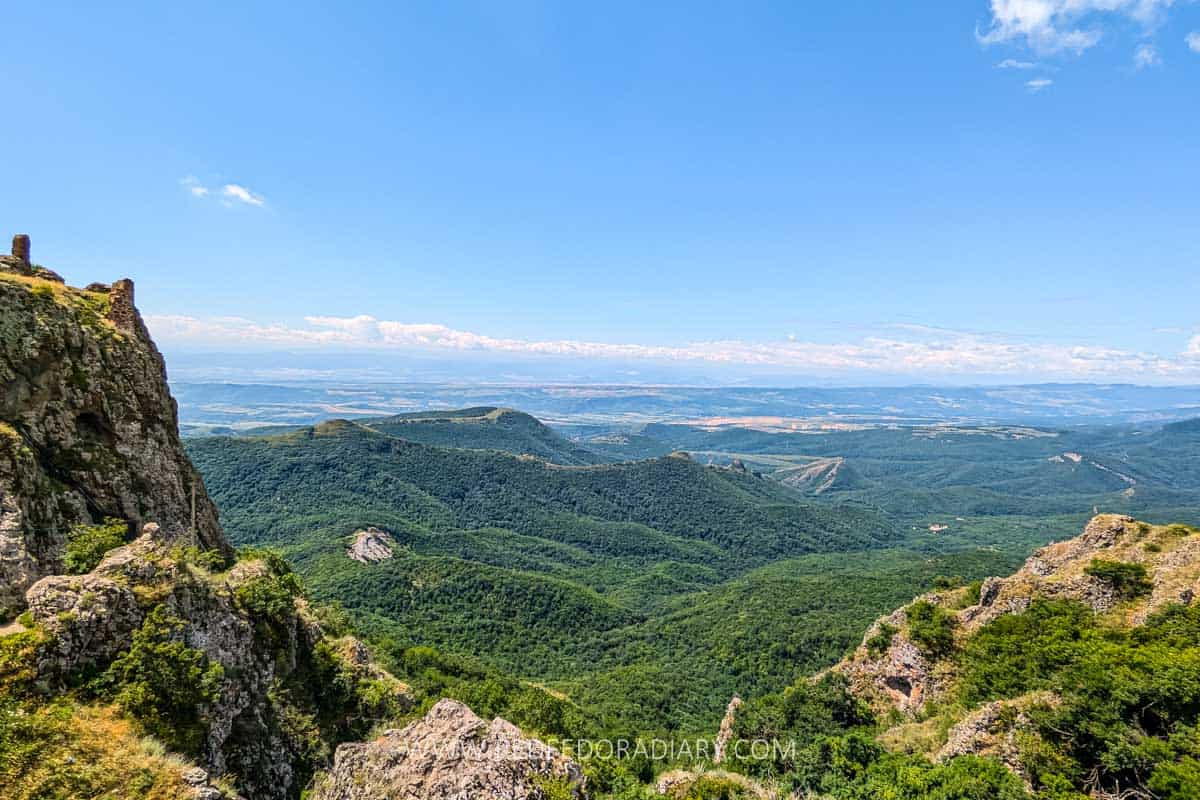
I am not a professional hiker nor a super enthusiastic one. I like easy hikes near Tbilisi to escape the noise and be close to nature to recharge and relax.
This specific Kojori to Asureti hike was surprisingly easy, with only 2-3 uphills. The trail mostly goes downhill and straightens up very often. On the way, there are a few exciting stops—a fortress, a church, a waterfall, and a reservoir.
That said, this quick guide documents how to get to Kojori, provides an overview of the hike, gives essential tips, lists what to bring, and recommends which maps to use to navigate yourself.
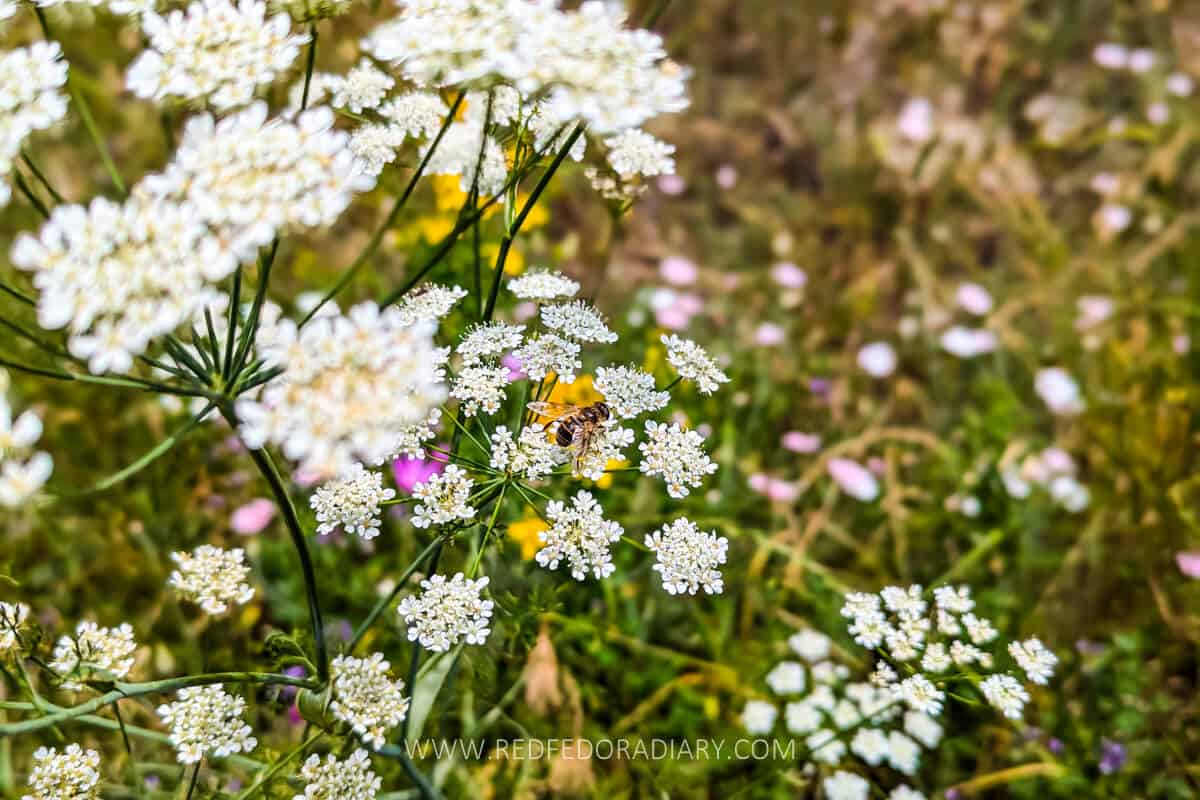
While this hike can be done independently, as we did, you can also join my friends and partners at WT Georgia, who frequently organize Kojori to Asureti hikes. This is ideal for those traveling solo or who want to avoid the hassle of transportation and rely on maps and trail markings.
My Travel Essentials
Get an eVisa: Check if you need one at iVisa and fill out the form to get your eVisa easily.
Book a flight: I use Skyscanner or WayAway. The latter offers cashback with a Plus membership.
Airport transfers: Avoid the hassle of public transport and pre-book a transfer with Gotrip.
Reserve a hotel: My go-to platform for hotels or apartments is Booking.com.
Wine tours: Eat This! Tours offer premium wine tours. Use code RFD5 to get 5% OFF.
Hiking & culture tours: WT Georgia is the best for unique trips. Email them Red Fedora & get 10% OFF.
Find best-suited tours: For other tours, entrance tickets, and activities, I use Viator or Get Your Guide.
Rent a car: With affordable prices, Local Rent is one of the best car rental platforms.
Hire a driver: GoTrip is ideal for long-distance private transfers at very reasonable prices.
Debit card: I have Wise (an alternative to Revolut) for local money withdrawals without hidden fees or high exchange rates.
eSIM: To avoid heavy roaming fees, use Airalo or Saily. Compare prices and GB packages. Use BAIA2592 on Airalo and BAIAIR6152 on Saily to get 3 USD on both.
Travel insurance: SafetyWing covers health insurance and has add-ons for adventure sports and electronics theft coverage.
Disclaimer: Some of the links in this post are affiliate links, which means I may earn a small commission if you buy something through them—at no extra cost to you. It helps support my blog and lets me share real, first-hand travel tips. Learn more
Why do a Kojori to Asureti hike
In addition to the fact that you’ll be spending a day in nature, the village of Asureti has a unique history that many foreigners miss, making it one of the lesser-known places in Georgia.
Formerly known as the Elizabethtal, the village of Asureti in the Kvemo Kartli region used to be home to German settlers, mainly Swabians from Württembergwas, who began immigrating to Georgia in the first half of the 19th century for various social and economic conditions.

By 1820, six German colonies were in the country, including Tbilisi’s Chughureti and Didube neighborhoods. Asureti is one of the few such settlements that is somewhat preserved and showcases typical German architecture using white stone and timber framing.
In 1941, Stalin exiled inhabitants of the Elizabethan to Central Asia and replaced them with people from the Racha region—only those who were married to a local managed to stay and survive.
A few years back, it also underwent a significant renovation, where the historic German houses and the Gothic Lutheran Church were reconstructed.
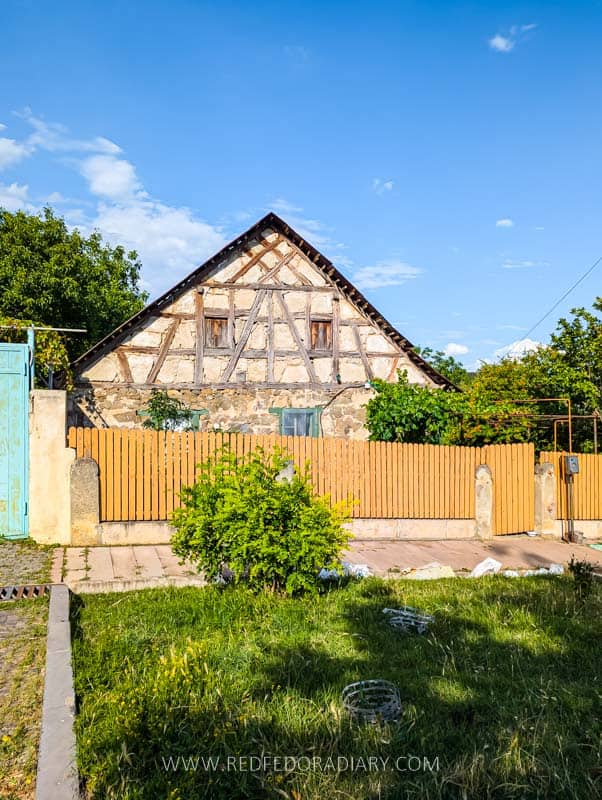
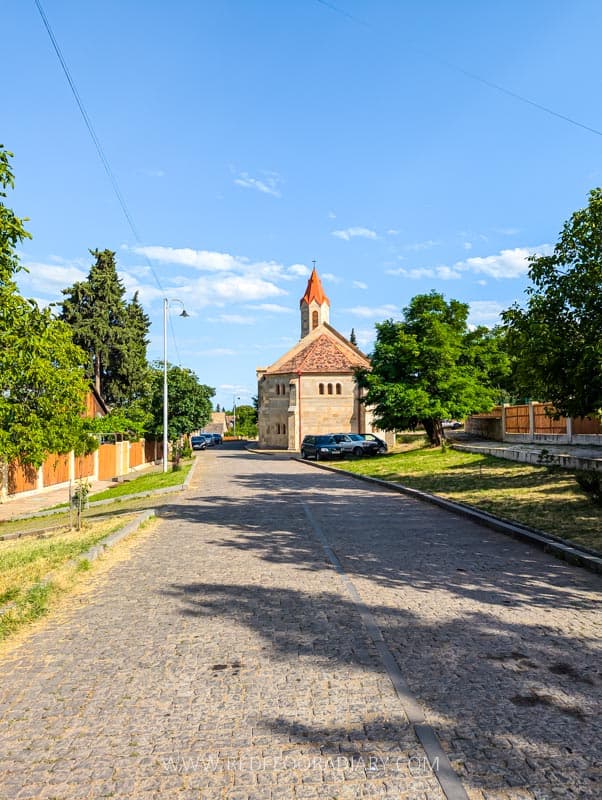
Apart from walking down Swab Street and peeking inside the church, you can also visit the typical German graveyard of the previous settlers, a wine factory where Germans produced their shala wine, and a Bahnhof Station restaurant serving a fusion of German and Racha cuisine.
The basics of Kojori to Asureti hike
Best time to do the hike
This Tbilisi day hike is doable year-round. Spring and autumn are the most pleasant seasons temperature-wise, with spring flowers and autumn foliage adding an extra charm to the trail.
We did the hike at the end of June, and since the temperatures in Kojori are more pleasant than in Tbilisi in summer, it was a nice escape from the city. Moreover, as the trail passed through the dense forest, we didn’t feel uncomfortable from the sun and the heat. In winter, the track will likely have snow and ice.
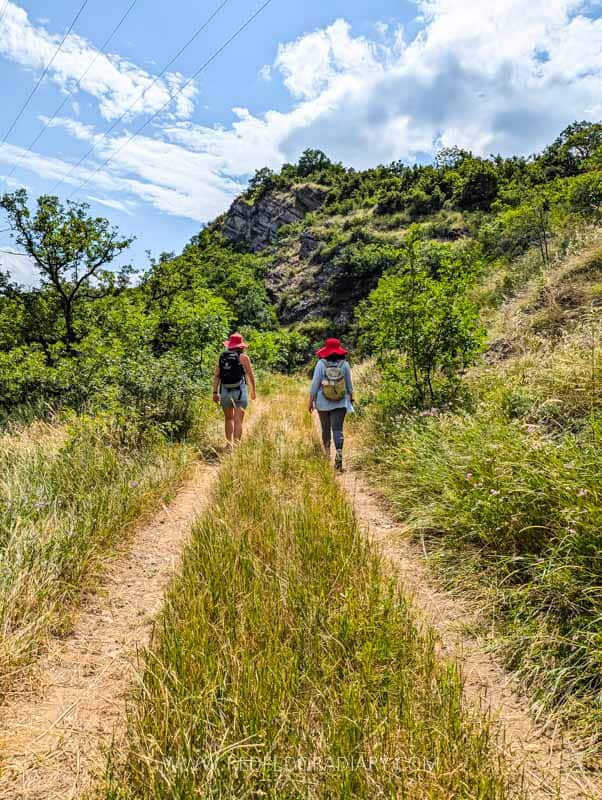
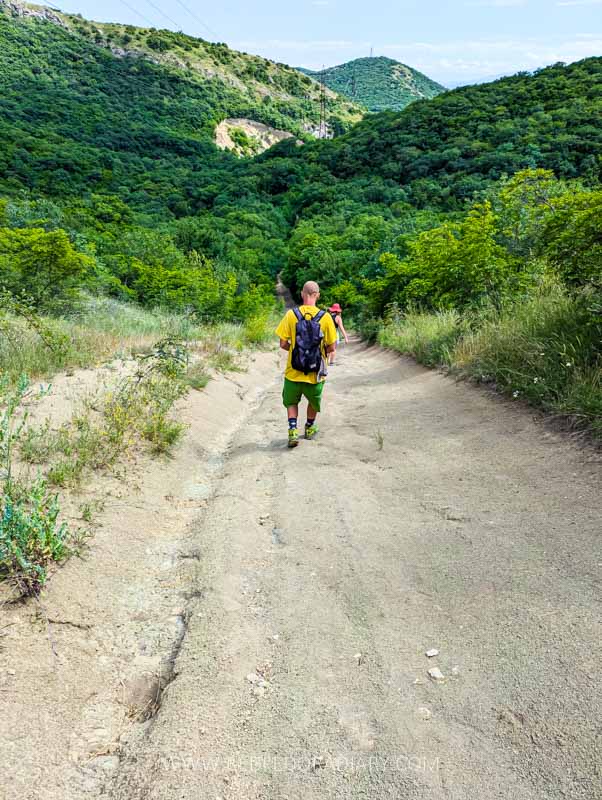
The hike has two steep downhills, one at the beginning and one after the waterfall I mentioned below. After heavy rain, it could be pretty muddy and slippery, so either skip it and do it some other time or be prepared with proper shoes or hiking poles.
How to get to Kojori
Getting to Kojori is straightforward. The only options are the city bus and a taxi. The Tbilisi to Kojori bus leaves from Baratashvili Street near Freedom Square. Bus number 380 goes directly to Kojori, while number 316 goes to Kiketi but passes by Kojori.
The 380 bus is the better option as it gets you closer to the trail’s starting point, Kojori Fortress, but sometimes, the bus runs late or is canceled at the last minute. Get off at the intersection of Azeula and Vazha Pshavela Street (here on Google Maps)
With the 316 bus, you can hop off at the Spar and Nikora shops in Kojori (here on Google Maps) and start walking towards the start of the trail, which will take an additional 20-30 minutes. The road does have markings and directions, so you won’t be lost. You can also check the timetables and routes at the TTC website or download their app.
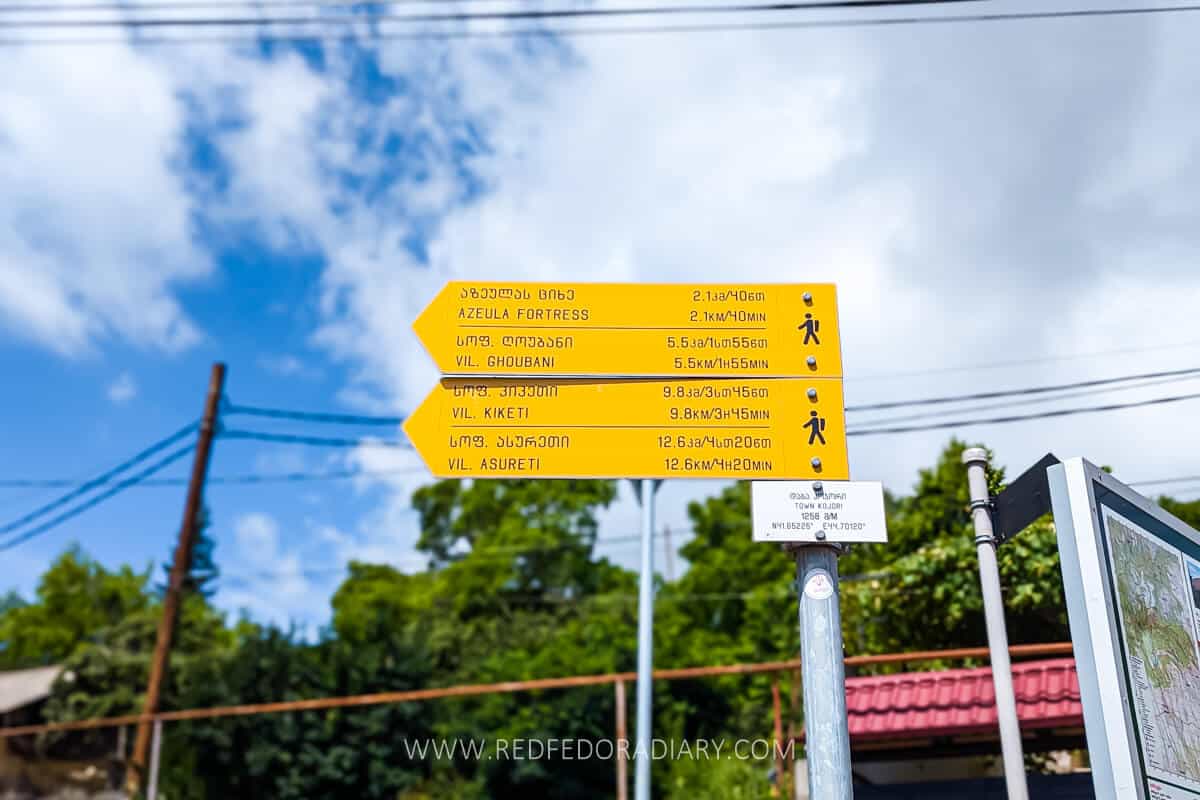
The buses usually run approximately every 40 minutes, from 7 am until 11 pm. The journey is around 40-50 minutes and costs only 1 GEL. It’s the same bus that runs through the neighborhoods of Tbilisi. Therefore, you’ll need a Tbilisi public transport card, or you can pay with your contactless debit/credit card. No cash payments.
Alternatively, you can order a taxi via the Bolt app and go directly to the starting point. The price of the ride depends on the location and time of ordering (if it’s a morning rush hour), but to give you an idea, it’s between 27-35 GEL from Baratashvili Street to Kojori Center.
How to get back from Asureti to Tbilisi
This is the trickiest part of the hike. Marshrutkas come from Tetritskaro or Tsalka, passing through Asureti. However, you’ll need to be very strategic about your time and finish the hike and optional dinner/late lunch at around 4 pm.
You’d need to wait for the marshrutka at the main highway and heil once you see Tbilisi or თბილისი written on it. Alternatively, you can hitchhike as well. We’ve done this ourselves, and so have a few of my friends who did precisely this hike or came back from Birtvisi or Tsalka (Dashbashi) canyons.
What to bring on Kojori to Asureti hike
There is no water source anywhere on the hike except for very sulfuric spring water closer to the Asureti village. So plenty of water is essential. If you are hiking in summer, I suggest freezing your water the night before and taking the ice on the hike. The ice didn’t melt for quite a while, and we enjoyed icy, refreshing water most of the hike.
Bringing a sandwich or a snack is essential, as you may get hungry on the way. If you get off bus number 380 earlier, you can bring them from Tbilisi or stock up at the Spar or Nikora shops. There are no proper picnic areas with chairs or tables, but there are plenty of spots in the shade to enjoy an impromptu short lunch in nature.
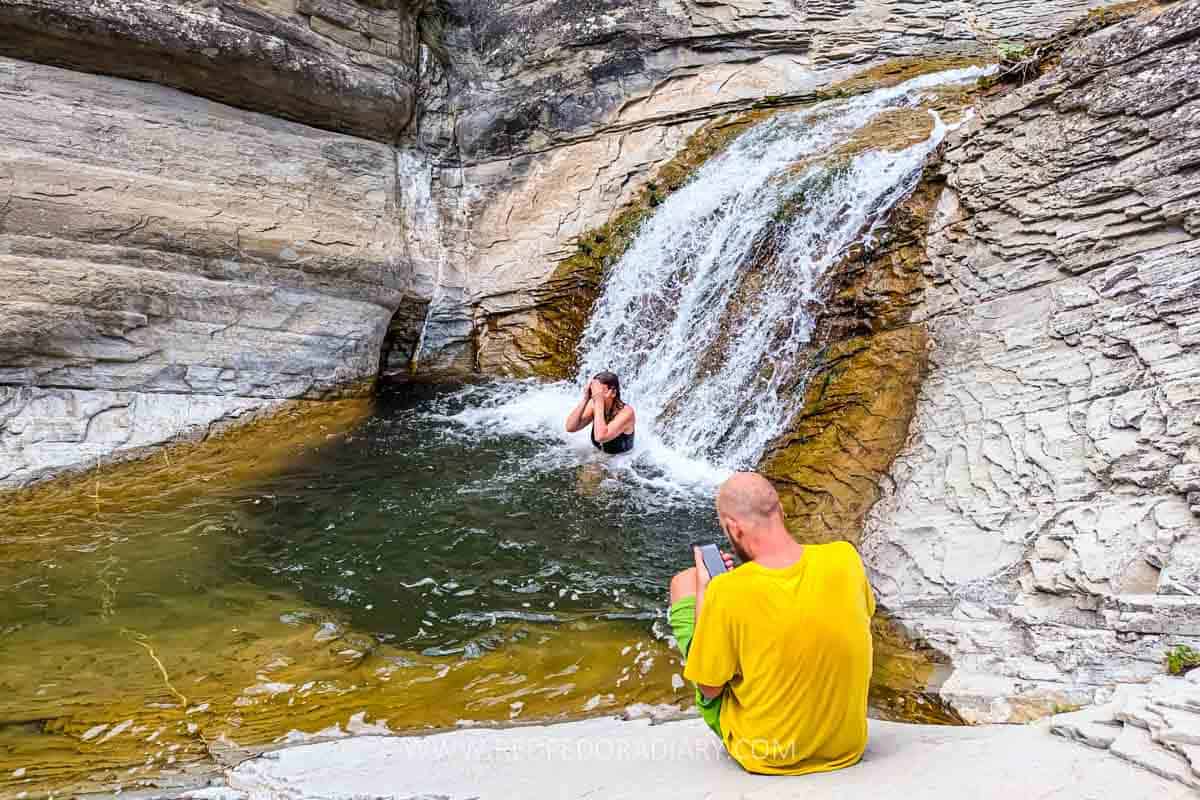
There’s a waterfall and a small pond for swimming on the way, so if you are hiking in summer and want to refresh, wear or bring a swimsuit. I provide the exact location of the waterfall later in the post.
Which map to use
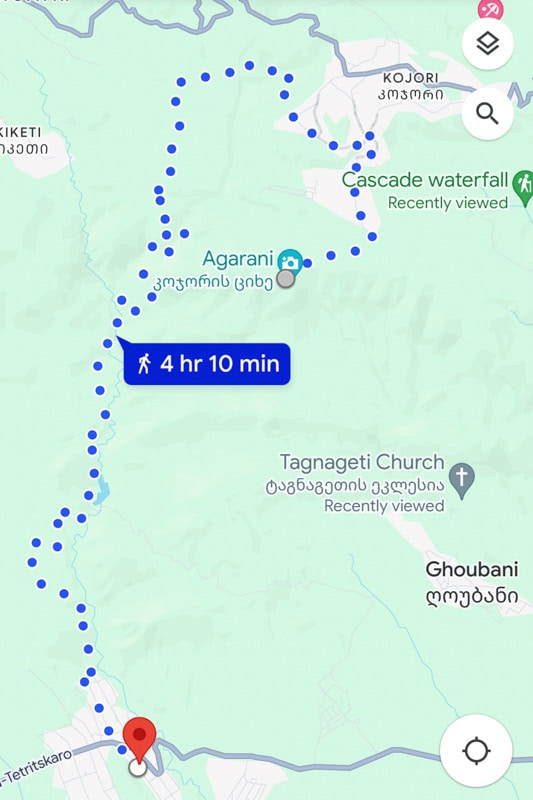
If you put walking directions on Google Maps from Kokjori Fortress to Asureti, it shows the trail but follows a different track than we did. It returns to the Kojori town and then takes a partially different track down to Asureti. Therefore, I wouldn’t rely on it, plus it’s a waste of time and energy. Even navigating yourself through the trail I explain below in Google Maps’s Satellite mode is quite tricky.
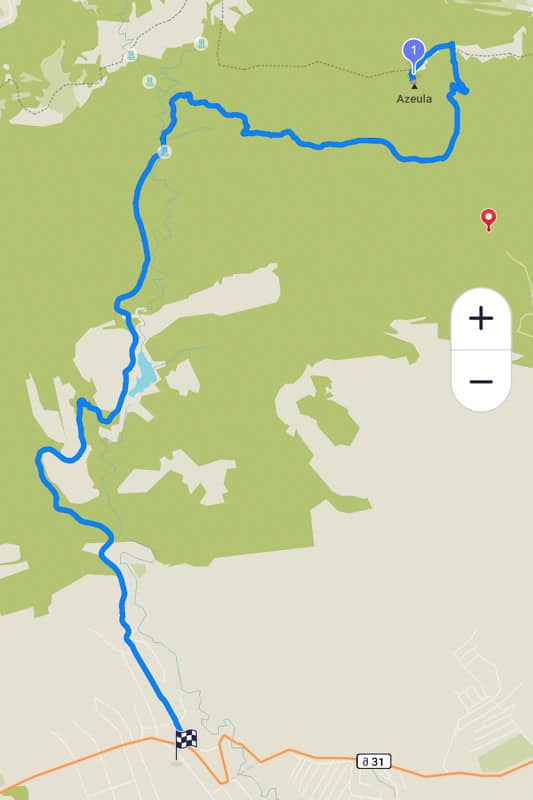
Instead, download Maps.me or Mapy.cz on your device and follow the route from Azeula Castle to Asureti (on Maps.me, it’s written Assureti, and on Mapy.cz – Asureti) – this is the exact track we used on our hike. Both work offline once you download the maps within the app, so you don’t need an internet connection.
NOTE: Mapy.cz also shows a slightly different route from Azeula Castle towards the Asureti, which is somewhat longer than we did.
However, I suggest you have a SIM card or an eSIM, just in case. If your device has eSIM support, I recommend Airalo or Saily as my internet providers when traveling. They both have coverage for Georgia. Compare the prices and get either one. You can use codes BAIA2592 on Airalo and BAIAIR6152 on Saily to get 3 USD on both.
What to wear on the Kojori to Asureti hike
You don’t need special hiking equipment since it is an easy hike near Tbilisi. I wore my low-ankle Salomon hiking shoes, and the rest of my friends and Oto wore hiking sandals and tennis shoes.
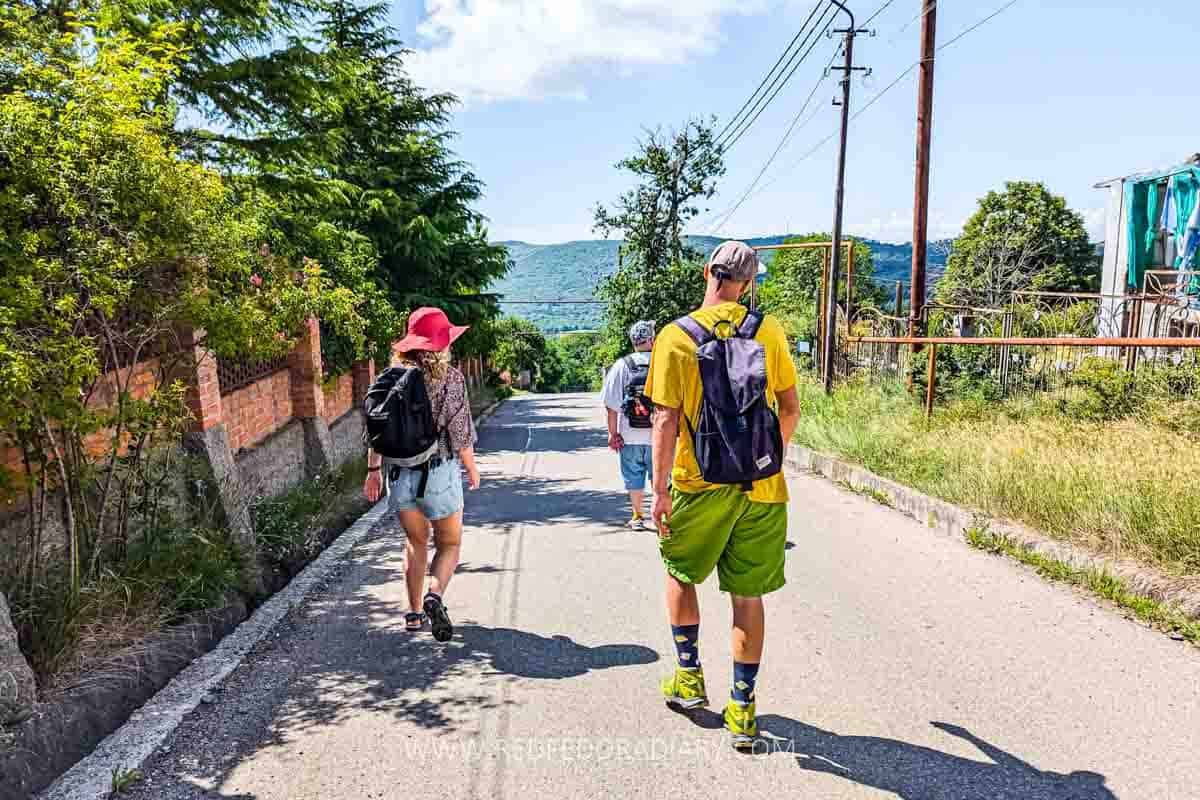
However, if you are hiking in other seasons, have appropriate gear. For winter, have a warm hat, layers, and gloves. Have a light cardigan or a jacket for early spring or late autumn. Packaging a raincoat just in case it rains is also a good idea.
A T-shirt, shorts, or leggings will do fine for clothes. Remember to wear a hat and sunscreen in summer as you walk under the sun in some parts of the trail.
Kojori to Asureti hike overview
Start your 12 km hike by visiting Kojori Fortress, then walk down towards Asureti village on a well-marked trail. Once in Asureti, do a bit of sightseeing, have an optional late lunch/dinner at the Bahnhof Station restaurant, or come directly to Tbilisi.
Allow around 4-5 hours for the hike, plus extra time for the fortress, picnics, and breaks.


From the trail start below Azeula Fortress, three 30-minute stops, and a dip in the waterfall, it took us five hours to get to the Asureti village entrance. You can watch my short reel of the hike as an Instagram Reel or a YouTube Short.
Then we decided to go to the Bahnhof Station to enjoy our well-deserved dinner and hitchhiked back to Tbilisi, as it was already late for the marshrutkas.
Kojori Fortress
The fort, also known as Azeula Fortress because of the hill it was built on, dates back to the 11th century. It had a protective purpose and controlled the caravan route from Tbilisi to Trialeti and from Garetubani (the center of Tbilisi) to Shida Kartli.
The fortress has had different rulers throughout history, from Georgians to Seljuk Turks (who renamed it Korogli Fortress). During the reign of King Tamar, she used it as her residence, and it is believed to be where she spent the last six months of her life and took her final breath. As a side note, it is an unsolved mystery where Georgia’s female ruler of the Golden Age is buried.

In more recent history, the Kojori Fortress was part of the battle for Tbilisi in 1921 when Georgians tried to defend the capital against the Red Army.
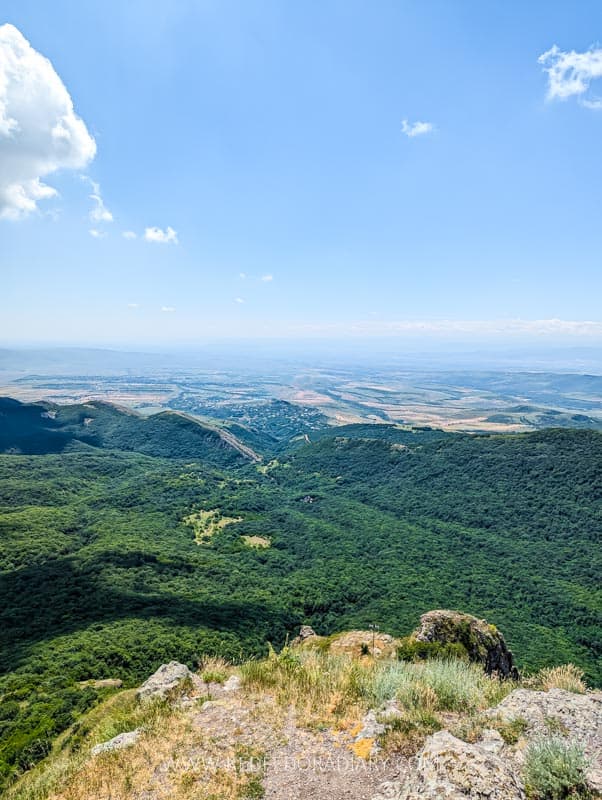
Although it’s mostly in ruins today, it remains a picturesque sight atop a rocky cliff of volcanic origin. At 1350 meters above sea level, the fort offers spectacular views that stretch far across the countryside, rolling hills, and villages.
You can also notice Kumisi Reservoir gleaming under the sun, the Saburtalo neighborhood in Tbilisi, and even the Greater Caucasus Mountain Range in clear weather.
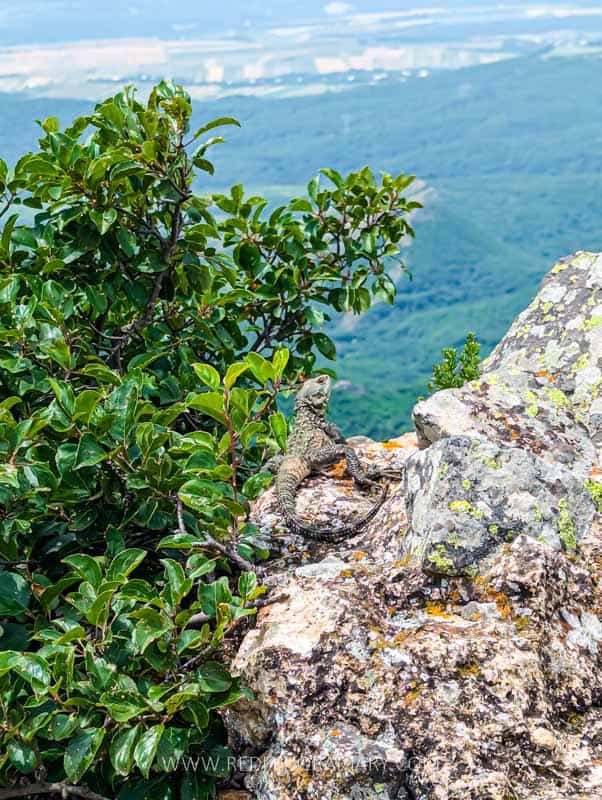
Follow Azeula Street until you reach Saint George Monastery and Yunker (Junker) Memorial. A few steps past these spots, you’ll find a dirt road leading to a short, relatively steep hike toward the foot of the fortress and a first viewpoint below it. To enter the fort on top, you’ll need to follow a trail through a narrow gap between the rocks and climb a metal staircase.
Fortress to Asureti village
Once you have explored the fortress from the inside, return to the church and the building next to it and find a trail mark to Asureti. The track is downhill from here but also levels out in some parts.
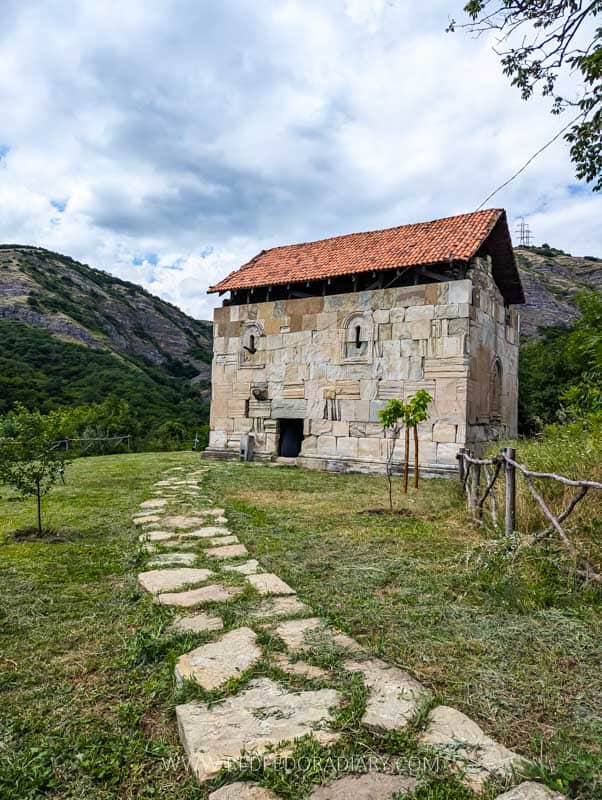
The trail is well-marked and winds through dense forests, open meadows, and rocky outcrops. About 4.4 km from the starting point, you’ll come across Kabani Monastery, a complex with several monuments. First, you’ll walk past the ruins of the churches before getting to the active one today.
After the Monastery, in about 500 meters, you can stop at 3 Waterfalls and dip in the Asuretiskhevi River. If you do so, you’d need to cross the river (barefoot or sandals) and then follow the stream a bit down to find a plunge pool. Otherwise, stay on the track and walk forward.
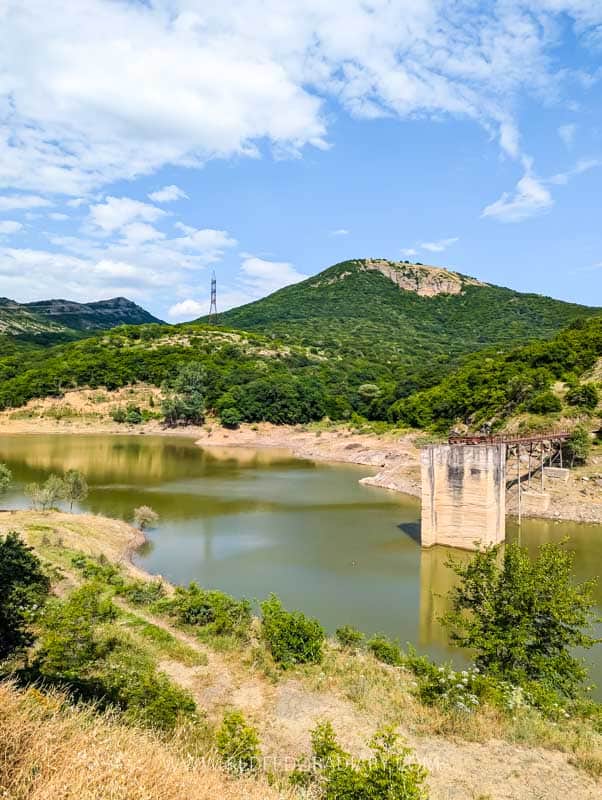
You’ll come across the abandoned hydropower dam about two kilometers from the waterfall. Afterward, you have another 3.7 km to the end of Asureti village. On the way, about 3 km from the dam, you’ll find spring water, but remember that it’s warm and tastes sulfur.
Once in Asureti, follow Swab Street, admire the centuries-old German houses, and peek inside the Gothic Church. If you want to visit the graveyard too, do so the first thing as you enter the Asureti village and turn right on a short uphill. The cemetery is marked on all three maps.
Rewarding dinner at Bahnhof Station
If you have time before returning to Tbilisi and want to have dinner in Asureti, head to the Bahnhof Station restaurant, a bit further away from the main Swabs Street.
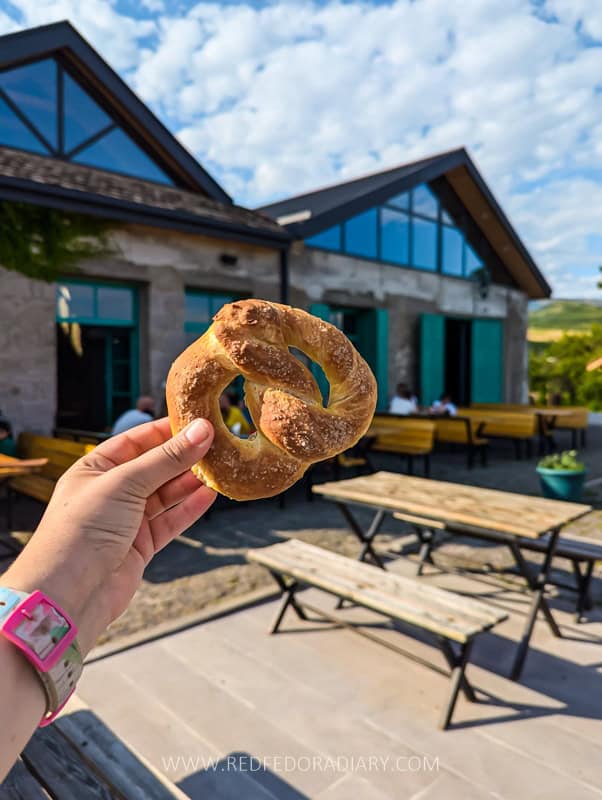
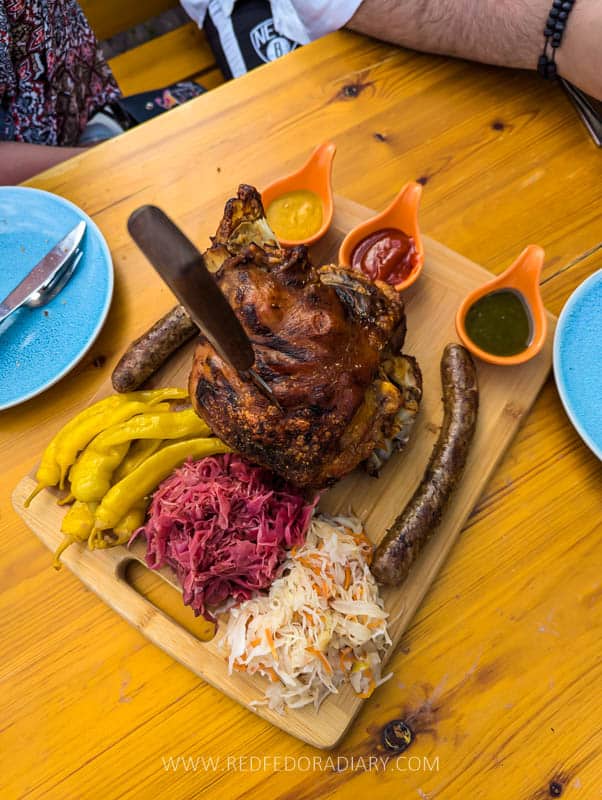
Bahnhof Station is designed as a beer garden and offers a mixture of German and Racha’s regional meals. After this hike, the place is a great relaxation spot, with plenty of outdoor and indoor seating.
The food and beer are excellent, and the atmosphere is simple, comfortable, and friendly. We opted for a pork shin roasted in the stone oven with sauces, two sausages, and pickles. It was delivered within 15-20 minutes of ordering. The pork meat was perfect—crispy skin and soft, almost melting inside.
We also had Rachuli Lobiani, the bean pie with ham from the Racha region, and homebaked crispy yet soft pretzels. The menu is quite diverse, with good options to suit every taste.